Oxygen Not Included Heat Management Explained: Why Every Successful Colony Becomes a Cooling Project
A systems-first deep dive into Oxygen Not Included heat management: where heat really comes from, why early cooling fixes fail, and how to build an industrial colony without slowly baking it alive.
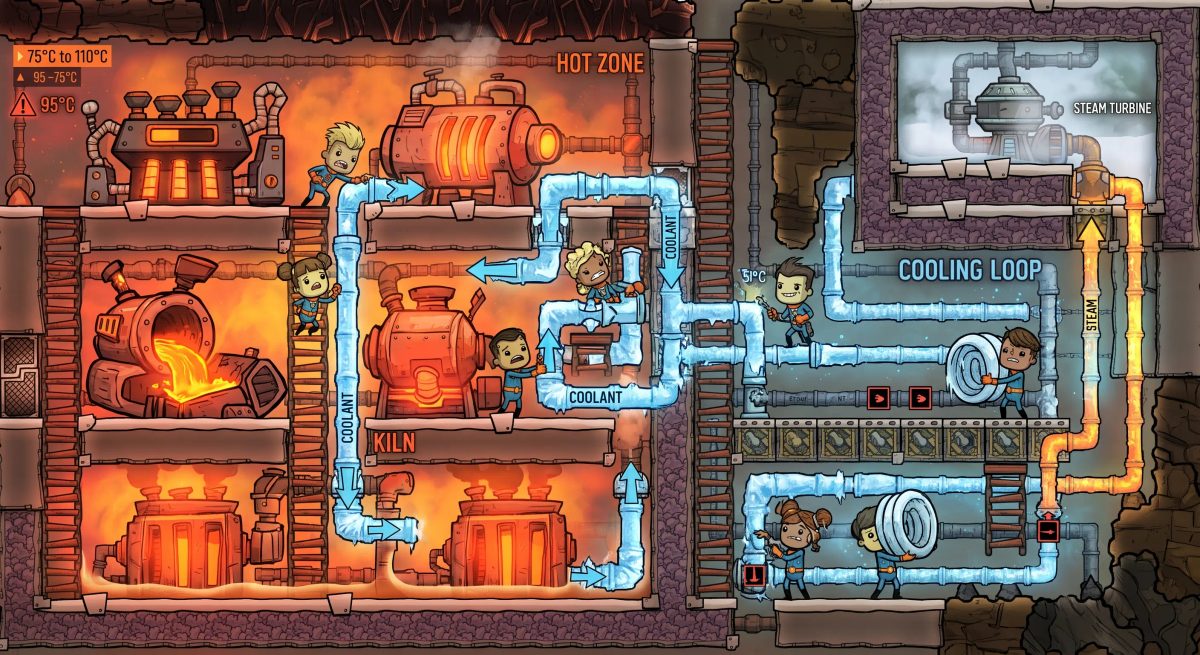
Your crops are stifling, the central base is climbing past 45°C, and coolant pipes keep bursting around a metal refinery that was fine twenty cycles ago. That is the usual Oxygen Not Included heat management crisis: not one broken building, but a delayed thermal bill the colony has been accruing since research and power started sharing space with farms.
This guide follows that problem from early game cooling through metal refining and the industrial brick. It is for colonies that can survive but cannot yet industrialize without cooking their farms, breaking coolant pipes, or turning every expansion into another emergency.
Quick take
When the colony starts warming, use this order before building a bigger aquatuner setup:
- Stop avoidable machine runtime.
- Separate farms and living spaces from generators, batteries, and industry.
- Buffer with cold biomes, ice, or other finite sinks only as temporary cover.
- Transport heat with a controlled liquid cooling loop.
- Delete continuous heat with a Thermo Aquatuner feeding a Steam Turbine.
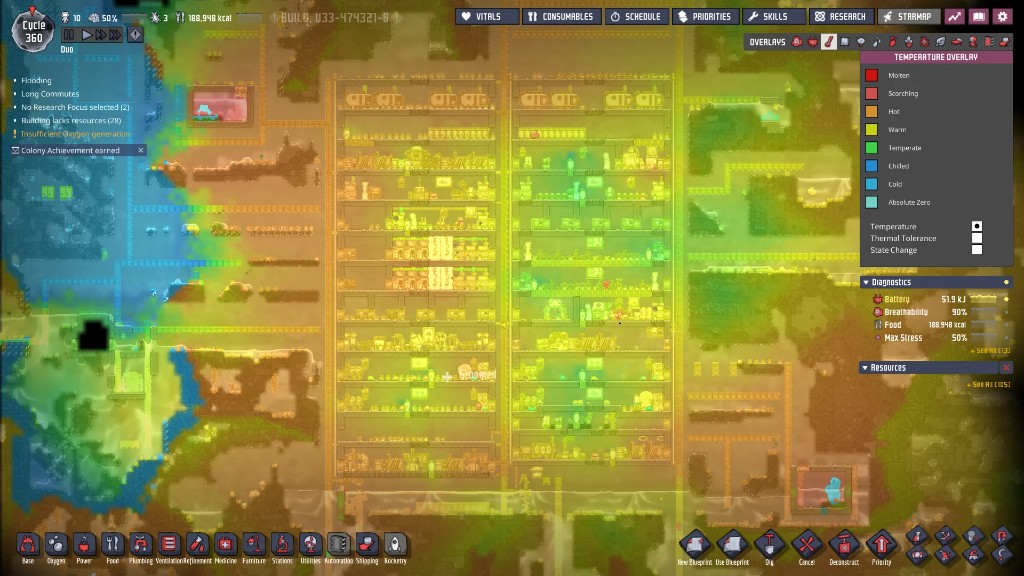
Temperature overlay first. Chase heat flow, not the single hottest tile.
Oxygen Not Included heat management is a heat-flow problem
Temperature tells you how hot something is. It does not tell you how much thermal energy it contains or how quickly that energy will move.
Three properties matter:
- Mass determines how much material can hold energy.
- Specific heat capacity determines how much energy is required to change that material's temperature.
- Thermal conductivity affects how quickly heat transfers between materials.
This is why a small pocket of very hot gas can matter less than a large reservoir of moderately warm water. The gas may show an alarming temperature in the overlay, but the water carries far more total energy. It is also why liquid cooling loops are much more effective than trying to solve every problem by chilling the surrounding oxygen.
Heat reaches the colony through several paths:
- Machines release heat while operating.
- Generators, batteries, transformers, and industrial equipment run for long periods.
- Hot liquids and gases enter through pipes.
- Warm materials are transported into cooler rooms.
- Heat leaks through tiles and doors from surrounding biomes.
- Coolant absorbs heat in one place and releases it somewhere else.
The last point causes many failed designs. An aquatuner, refinery coolant loop, or cold-biome pipe does not make heat disappear by itself. It changes the location of that heat.
A functional plan therefore needs to answer two questions:
- What must remain cool?
- Where will the removed heat ultimately go?
If the second answer is only “outside the farm,” the design is temporary.
The first heat crisis is usually a delayed bill
A refinery often gets blamed for a colony's first serious temperature problem, but the crisis usually began much earlier.
Research equipment, batteries, generators, cooking, oxygen production, and basic processing may all be placed near the printing pod because that area is convenient. None looks catastrophic alone. Together, they steadily raise the temperature of the same central mass of tiles, gases, buildings, and stored resources.
The delay makes the cause difficult to read. A colony can appear stable for dozens of cycles while its surroundings absorb the output. Crops keep growing until their local temperature crosses a limit, at which point food production drops abruptly. By then, the nearby rock, floors, storage, and oxygen may all be warm.
Insulated tiles can delay that transfer, but they cannot fix a room that produces heat continuously. Sealing generators, batteries, and processing equipment inside an insulated box simply creates a hotter box. Eventually the machinery overheats or the heat escapes through doors, pipes, and other connections.
The right early diagnosis is not “the base needs cooling.” It is more specific:
- Which room is generating the heat?
- Which route carries it toward sensitive areas?
- Which systems actually need temperature control?
- Is the current cooling method removing energy or merely storing it?
Use the temperature overlay before rearranging machinery. Look for gradients rather than isolated hot cells. A widening warm area usually reveals the source and transfer path more clearly than the hottest single tile.
Prevent and relocate before building active cooling
Oxygen Not Included early game heat is best handled by reducing unnecessary production and keeping the remaining sources away from temperature-sensitive systems.
Start with zoning. Farms and other systems with narrow operating ranges belong in a protected core. Generators, batteries, kilns, crushers, and later industrial machinery should sit outside that core, ideally with an insulated boundary between them.
That separation does not need to be elegant. Its purpose is to buy time while keeping one local problem from becoming a colony-wide problem.
Several measures have an outsized effect early:
- Automate generators. Smart battery control prevents fuel generators from running when their power is not needed. Less runtime means less heat as well as less fuel consumption.
- Keep hot pipes out of farms. Insulate hot liquid and gas lines, then route them through industrial corridors rather than convenient living spaces.
- Insulate selectively. Protect the colony from hot surrounding biomes, but avoid sealing active heat sources into rooms with no cooling plan.
- Move intermittent processing outward. Equipment used occasionally can tolerate a remote location better than a farm can tolerate gradual warming.
- Do not cool unused volume. Cooling every bedroom, hallway, and storage room is usually wasted capacity. Stabilize crops, critical machinery, and key resource streams first.
The common mistake here is treating the whole central base as one temperature zone. It is easier to maintain a small cool agricultural area and a separate warm industrial area than to force both toward the same target.
Relocation remains a temporary measure if the industrial zone runs continuously. It is still the correct first step because it gives active cooling a defined job later.
Cold biomes store heat; Wheezeworts delete a little of it
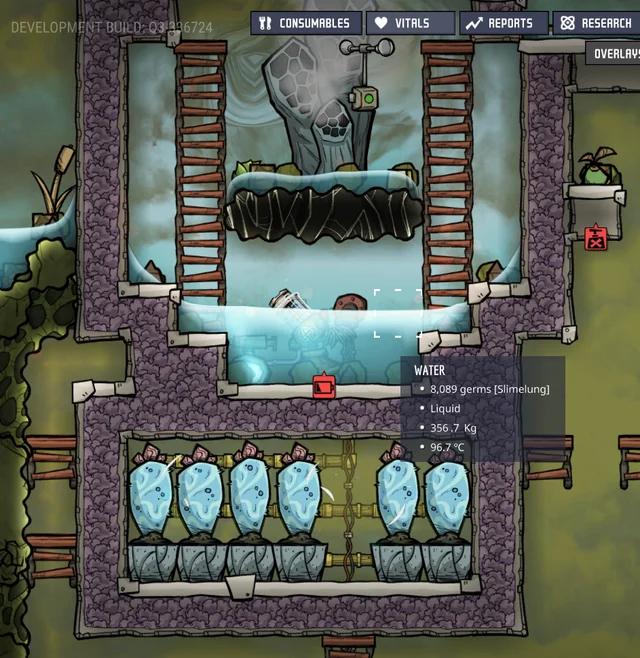
Cold biomes feel like free cooling because their terrain and materials can absorb a large amount of energy. Running a warm liquid loop through one can keep early machinery or farms stable for a long time.
The biome is not deleting that heat. Its ice, rock, liquids, and gases are warming while acting as a thermal battery. Once enough energy has accumulated, the loop returns warmer and the cooling effect fades.
That does not make cold biomes bad. They are useful for:
- Protecting a farm during expansion.
- Cooling a limited supply of warm water.
- Buffering an early oxygen line.
- Supporting temporary metal refining.
- Buying construction time for a permanent system.
They become a liability when the colony quietly depends on them for continuous industry. A refinery and sustained power generation can consume a finite cold reserve much faster than basic farming or research.
Wheezeworts are different: they actually delete heat by cooling the gas they process. Their limitation is capacity, not storage. A compact room can use them for local hot spots, but their throughput and operating requirements make them awkward as the sole answer to a large industrial load. Scattering them around a hot base also treats symptoms rather than fixing heat flow.
Ice-based emergency cooling can rescue a farm, especially when the resulting cold water is contained and managed. It should still be understood as spending a finite cold resource.
A good rule is simple: if a cooling method gradually warms something else, it is a heat sink with a capacity. Permanent industry eventually needs sustained heat deletion, usually from an aquatuner and steam turbine pair rather than another cold pocket.
Active cooling must transport heat before deleting it
The Thermo Aquatuner is the core of most serious liquid cooling systems, but it is not a heat deletion machine.
Each processed liquid packet leaves the aquatuner 14°C colder. The thermal energy removed from that packet is deposited into the aquatuner and its surroundings. A high-specific-heat coolant lets the machine move more energy per packet, provided the liquid remains safely within its freezing and boiling range.
An aquatuner placed in an ordinary room will cool its pipe while overheating itself and the room. That setup has moved heat from the coolant into the colony without creating an exit.
The standard permanent answer pairs the aquatuner with a Steam Turbine:
- A liquid loop collects heat from the target area.
- The aquatuner cools the returning liquid.
- The aquatuner releases the removed energy into a sealed steam chamber.
- Steam absorbs that energy and becomes hot enough for the turbine.
- The turbine condenses the steam, converts part of the thermal energy into power, and returns water to the chamber.
- The turbine itself receives controlled cooling from the liquid loop or another suitable source.
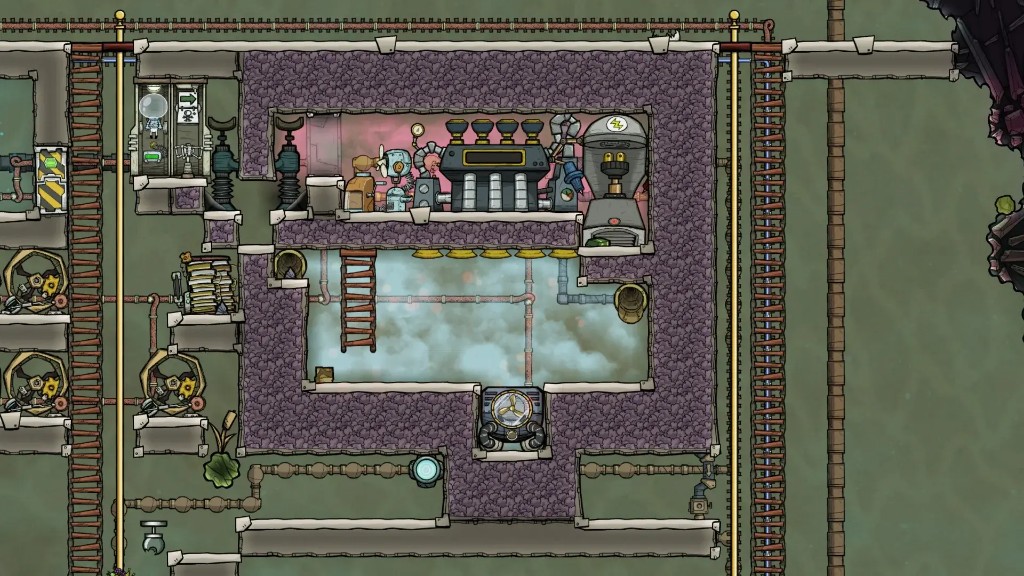
This creates a managed hot side and cold side. The aquatuner transports heat into the chamber. The steam turbine provides the sustained heat deletion.
Build the cold side around a specific target
Do not begin by laying radiant pipe through the entire colony. Choose a load:
- A farm.
- A compact living core.
- An oxygen line.
- Industrial machinery with an operating-temperature limit.
- A liquid reservoir that must remain within a safe range.
Use radiant piping only where heat exchange is wanted. Use insulated piping everywhere else. A cooling loop that absorbs corridor heat on its way to the farm may arrive with too little capacity left for the actual target.
A liquid reservoir can help average packet temperatures and prevent sharp swings. It also makes automation more predictable when the returning coolant varies in temperature.
Protect the coolant's phase range
Aquatuners apply the same temperature drop to each packet, so cold coolant can freeze in the output pipe if allowed through at the wrong temperature. A Pipe Thermo Sensor and bypass let liquid skip cooling when another 14°C reduction would be unsafe.
This is where many compact designs get tricky. The aquatuner may be functional, but a blocked bypass, poorly placed bridge, or badly configured sensor causes intermittent flow. Cooling then becomes inconsistent precisely when the colony's heat load increases.
The design should fail safely. If the aquatuner turns off, coolant still needs a valid route around it.
The steam turbine needs cooling too
A steam turbine does not remove every consequence of the heat it processes. The turbine building itself warms during operation and can eventually stop working if that heat is ignored.
Often, the same aquatuner loop can cool the turbine before traveling to its primary target. That adds load, so the loop must have enough capacity for both jobs. If the turbine is barely staying within range while the farm keeps warming, the system is undersized rather than mysteriously broken.
The metal refinery changes the scale of the problem
A Metal Refinery makes the colony's thermal accounting impossible to ignore. Refining injects substantial heat into its coolant. Occasional batches are manageable; continuous industrial work is not.
There are two practical stages.
Early refining can use disposable coolant
A temporary refinery can take cool liquid from a reservoir and send the heated output somewhere that can safely store or use it. This avoids recirculating increasingly hot coolant through the machine.
It is a workable bridge for limited production. It is not a closed industrial system, and the hot output still has to be managed. Dumping it into the central water supply merely moves the heat into another important resource.
Water-based coolants also have phase limits. A recipe can add enough energy to create boiling risk if the input is already too warm. Pipe damage is not a refinery mystery; it usually means the coolant choice or starting temperature was inappropriate for the thermal load.
Continuous refining needs a deliberate hot loop
A mature refinery loop commonly uses a liquid with a wider high-temperature operating range, such as petroleum or crude oil. These liquids can tolerate temperatures that would turn water-based coolant into steam, though their thermal properties produce different temperature changes per operation.
The loop then sends hot coolant through radiant pipes inside a steam chamber. Heat transfers from the coolant into the steam, after which the cooler liquid returns to the refinery. The steam turbine handles the chamber's accumulating energy.
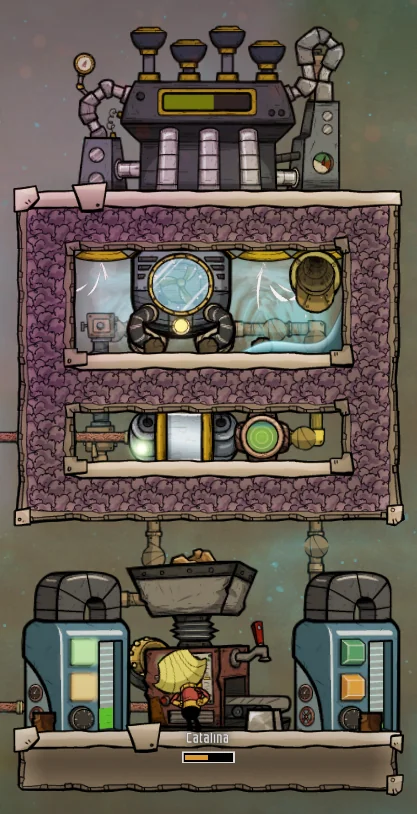
This arrangement does not require the aquatuner to cool the refinery coolant. The refinery raises the coolant temperature, the chamber absorbs that heat, and the turbine processes it. Insulated pipes between the refinery and chamber prevent that energy from leaking into unrelated rooms.
A stable refinery loop should answer four questions:
- Can the coolant remain liquid after the hottest recipe?
- Is there enough radiant exchange area to cool it before the next operation?
- Can the steam turbine process the average heat load?
- Where does turbine cooling come from?
If any answer is vague, sustained refining will eventually expose the weakness.
An industrial brick is useful only when its boundaries are real
An Oxygen Not Included industrial brick centralizes heat-producing machinery, power connections, material handling, and cooling. The value is containment. Heat has fewer routes into farms and living areas, while cooling infrastructure can serve several machines.
A conventional cooled brick is the easier first step. Machinery stays within a controlled temperature range while a liquid loop moves its heat into a dedicated steam chamber.
A hot industrial sauna goes further by placing suitable machinery directly in a steam environment, allowing its operating heat to feed the turbine system. That can be effective, but it is not automatically superior. Building materials must tolerate the operating temperature, duplicant access becomes less convenient, and machine outputs may create additional temperature or phase-management problems.
For many colonies, forcing every industrial machine into one hot chamber adds complexity without solving a real bottleneck. Keep equipment outside when its inputs, outputs, access needs, or temperature limits make the sauna awkward.
The industrial brick succeeds when every major heat flow is intentional:
- Machinery releases heat into a controlled zone.
- Coolant carries concentrated refinery heat to the steam chamber.
- Insulated boundaries protect the rest of the colony.
- Turbines process the hot side.
- A dedicated loop keeps turbines and temperature-limited equipment operational.
An insulated room full of machines is not an industrial brick. It is a delayed overheat event.
A practical cooling decision order
When a stable colony begins warming, use this order rather than immediately building the largest possible aquatuner loop.
| Symptom | Likely problem | First response |
|---|---|---|
| A farm warms from one side | Heat leaking from a biome or nearby room | Add a selective insulated boundary and reroute hot pipes |
| Generators warm the central base | Poor zoning and unnecessary runtime | Move power outward and automate generators |
| A cold biome no longer cools a loop | The finite heat sink is becoming saturated | Reduce the load and prepare active cooling |
| Refinery output breaks pipes | Coolant crosses its phase limit | Change coolant, lower its starting temperature, or stop recirculating it |
| An aquatuner room overheats | Heat is being moved but not deleted | Build a managed steam chamber and turbine |
| The turbine overheats | Hot-side support cooling is undersized | Expand or reprioritize the cooling loop |
| The whole base is warm but only crops fail | Cooling scope is too broad | Cool the farm first instead of all colony air |
The priority is stop, separate, buffer, transport, delete.
Stop avoidable machinery runtime. Separate sensitive systems from hot ones. Use finite cold reserves as a buffer. Transport heat with a controlled liquid loop. Add deletion once the load becomes continuous.
The relevant pick for systems-heavy colony sim players
Oxygen Not Included fits players who find the cooling project itself satisfying rather than intrusive. Anyone seeking a forgiving colony sim should treat this level of thermodynamic dependency as a warning, not a bonus.
Oxygen Not IncludedFAQ
Do insulated tiles solve heat problems?
They slow heat transfer. They do not remove thermal energy, and they cannot stabilize a room that continuously produces more heat than it exports. Use them to protect cool areas and define the boundaries of a cooling system.
Does a thermo aquatuner delete heat?
No. It removes heat from a liquid and deposits that energy into itself and the surrounding environment. Pairing it with a properly managed steam turbine creates the permanent heat-deletion system.
What is the best early cooling method?
Reduce generation, automate power, move hot machinery away from farms, and use selective insulation. That is the best ONI early game cooling plan. Cold biomes, Wheezeworts, and ice can buy time, but they should not be mistaken for an unlimited industrial solution.
Should the entire colony be cooled?
Usually not. Farms, turbine rooms, critical machinery, and selected liquid or oxygen streams are better initial targets. Cooling large volumes of ordinary base air consumes capacity without necessarily protecting the systems that are failing.
When should an aquatuner and steam turbine be built?
Build the pair when the colony has a continuous heat load that passive sinks cannot absorb indefinitely. Metal refining, sustained industry, and a permanently controlled agricultural zone are common reasons to make the transition.
Is water always the best coolant?
Water and polluted water are effective in many moderate-temperature loops because of their thermal properties, but their phase ranges matter. High-temperature refinery loops often need a liquid such as petroleum or crude oil that can remain stable at higher temperatures. The correct coolant depends on both heat capacity and expected operating range.
Takeaway
Successful Oxygen Not Included heat management follows the energy instead of chasing the hottest visible tile. Early colonies can prevent and relocate heat, midgame colonies can store it in finite sinks, but sustained industry requires controlled transport and real heat deletion.
Build around that progression. Protect the farm, isolate the machinery, give refinery coolant a safe loop, and make the industrial brick a destination for heat rather than another insulated box waiting to fail.