Oxygen Not Included vs Stationeers: Which Engineering Survival Sim Should You Play?
Oxygen Not Included is a 2D colony overseer game. Stationeers is first-person space engineering. Compare control, failure, automation, exploration, and co-op to pick the right one.
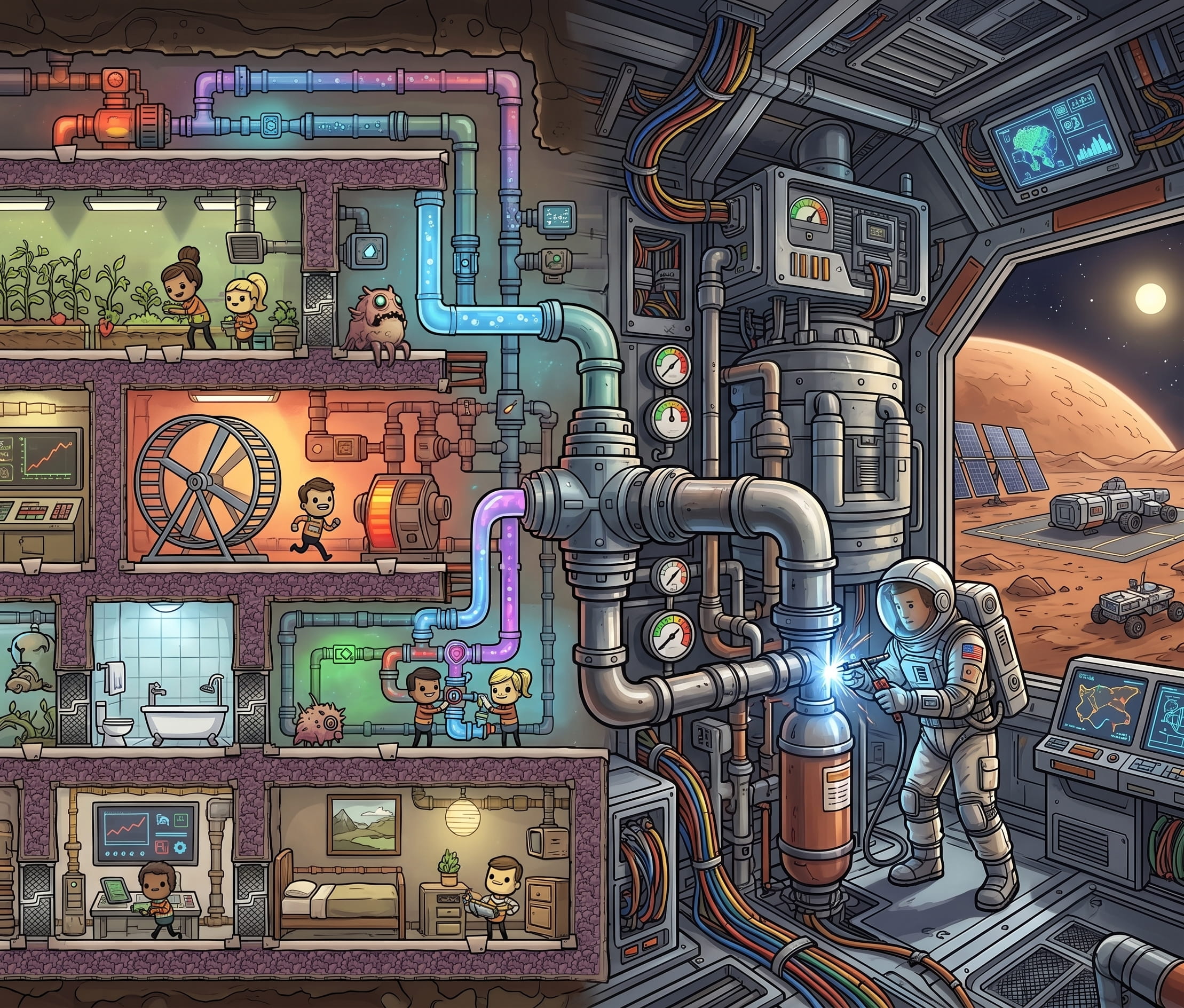
The Oxygen Not Included vs Stationeers choice is not about which game has more systems. Both simulate gases, heat, power, and plumbing in serious detail. The real split is how you interact with those systems.
Do you want to pause a 2D colony and manage duplicants, or put on a suit and weld the pipes yourself?
Oxygen Not Included is a colony sim. You are an overseer. Stationeers is a first-person engineering survival game. You are the technician.
Quick take
- Pick Oxygen Not Included if you want a readable 2D colony with duplicant drama, delayed heat and gas problems, and time controls that let you think before you act.
- Pick Stationeers if you want to personally mine, fabricate, pipe, and debug a habitat on a hostile world.
- Oxygen Not Included looks friendlier, but weak layouts still cook, flood, or suffocate a colony many cycles later.
- Stationeers is harsher up front: a bad pipe, empty canister, or unsealed room can kill you immediately.
- Stationeers is the co-op game. Oxygen Not Included is single-player.
Oxygen Not Included vs Stationeers at a glance
| Category | Oxygen Not Included | Stationeers |
|---|---|---|
| Perspective | 2D side-view, pauseable | First-person, real-time |
| Your role | Colony overseer | Hands-on engineer |
| What you control | Priorities, rooms, and systems; duplicants do the labor | Your character, tools, and every machine you place |
| Failure | Delayed: heat, gases, and bottlenecks show up after the colony grows | Immediate: vacuum, pressure, power, and suit mistakes |
| Automation | Visual sensors and logic gates | Devices plus IC10 chip programming |
| Exploration | Dig through biomes, geysers, oil, and space | Mine hostile planets, work in vacuum, travel between worlds |
| Multiplayer | No official co-op | Online and LAN co-op |
| Mods | Large Steam Workshop scene | Workshop worlds, saves, and mods |
| Best for | Colony-sim players who like interconnected ecosystems | Players who want physical engineering and co-op |
Colony overseer versus first-person engineer
This is the difference that decides the purchase for most people.
In Oxygen Not Included, you never walk the base. You draw pipes, set priorities, and watch duplicants carry out the work. The engineering is real — oxygen production, plumbing, power, temperature, germs — but it is filtered through a population. A bad oxygen loop is a colony story: stressed duplicants, stalled research, a room that slowly becomes unlivable.
That distance is the point. You can pause, zoom out, and treat the asteroid as a system. The cartoon presentation makes the early game look gentle. It is not. The simulation underneath is strict.
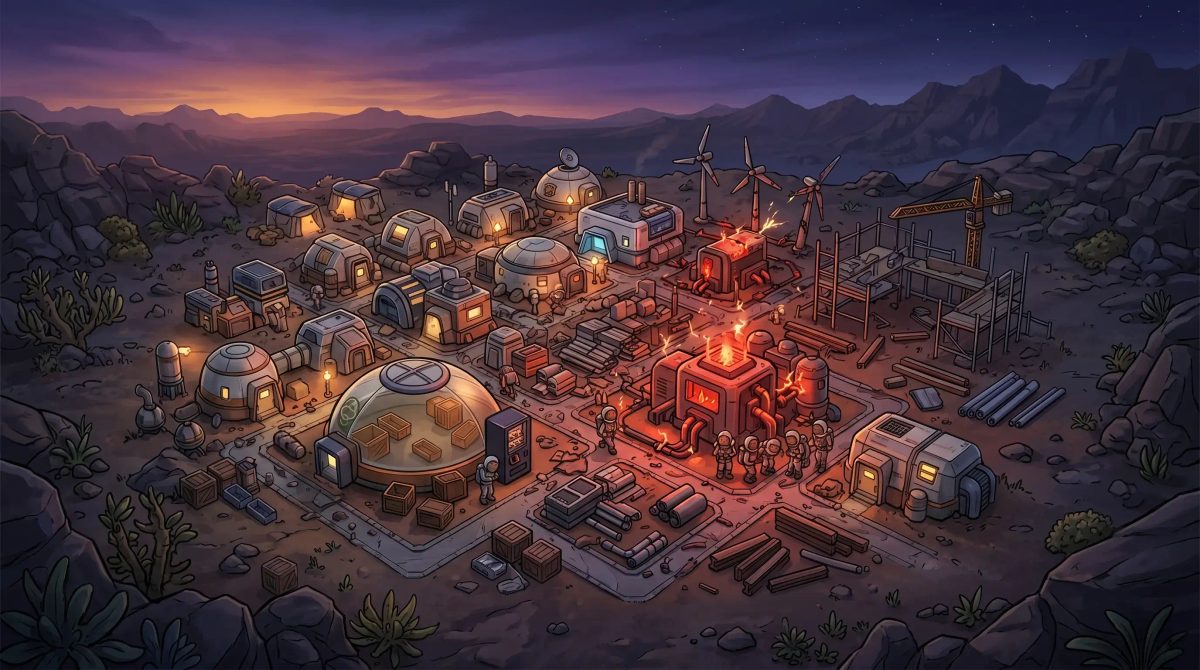
Stationeers puts you inside the habitat. You mine ore, weld frames, place cables, fill canisters, and stand in the room whose atmosphere you just mixed. Default starts are hostile planets such as the Moon or Mars, not a cozy orbital lobby. If a wall is open to vacuum, you feel it. If a pipe carries the wrong gas, you diagnose it with a tablet in your hand.
That is why Stationeers feels more like a physical engineering sandbox and Oxygen Not Included feels more like a colony manager. Both are about life support. Only one makes you the person keeping it running.
Difficulty is a different clock, not a higher number
Neither game is the “easy” version of the other.
Oxygen Not Included punishes you later. A room can have enough oxygen today while heat from generators creeps into the farms. A coal plant can look fine until the colony’s demand outgrows it. A plumbing layout that worked at six duplicants becomes a bottleneck at twenty. The skill is thinking several systems ahead, not just plugging the shortage on screen.
Stationeers punishes you now. Pipe contents, pressure, temperature, and power state matter immediately. A missing valve, an unsealed airlock, or a power network that cannot start itself can take a habitat down before it ever becomes a “base.” The skill is understanding the machine you just built, not waiting for a graph to go red fifty cycles later.
If you like learning through broad colony-level decisions and delayed consequences, Oxygen Not Included fits. If you like tracing a failure through a specific network until you find the broken link, Stationeers fits.
Automation, exploration, and what you actually build
Automation exists in both games. It does different jobs.
Oxygen Not Included’s automation overlay is colony infrastructure: sensors, gates, and ribbons that keep bathrooms cycling, coolers from freezing pipes, and factories from running when they should not. The design question is which problems deserve circuitry, and how that circuitry sits inside heat, power, and resource budgets.
Stationeers treats control systems as part of the station. You wire devices, then often write IC10 code on chips when the logic gets serious. That is closer to industrial control than to a colony overlay. It is more ownership, and a steeper skill jump.
Exploration splits the same way. Oxygen Not Included is a dig. You push into slime, ice, caustic, oil, and space, hunting geysers and resources that change what the colony can sustain. Stationeers is a surface-and-space survival loop: mine a hostile world, live in vacuum or thin atmosphere, then use rocketry to reach other planets. One game expands a closed ecosystem. The other expands a constructed habitat against an environment that wants you dead.
Co-op and mods
Stationeers supports official online and LAN co-op. That is the practical reason to pick it if you want to split power, atmosphere, mining, and fabrication with other people. It can also make the work harder: a badly coordinated station is worse than a messy solo build.
Oxygen Not Included has no official multiplayer. Shared engineering is not part of the design.
Both games have Steam Workshop support. Oxygen Not Included’s mod scene is larger and more established. Stationeers Workshop is useful for worlds, saves, and station setups, but it is not a reason to pick Stationeers over Oxygen Not Included on mods alone. Pick Stationeers for co-op. Pick Oxygen Not Included if you mainly care about a deep single-player mod ecosystem.
Who should pick what?
Pick Oxygen Not Included if you want colony stories
Choose it when the fun is watching a settlement live with your engineering decisions. You want priorities, duplicant needs, room planning, and a colony that develops a rhythm — then breaks it when heat, oxygen, or plumbing catch up.
It is also the better first game for players coming from RimWorld, Surviving Mars, or other colony sims. The 2D view and pause make the whole base readable. The limitation is the overseer role itself. If you want to hold the wrench, the duplicants will feel like a layer between you and the pipes.
Pick Stationeers if you want to build the machine
Choose it when the infrastructure is the game. You want to design atmospheres, power networks, fabrication lines, and control logic yourself, then live inside the result. The payoff is a habitat that works because you understood the connections.
The tradeoff is the onboarding. Stationeers asks for more knowledge before it feels generous, and it is still a hardcore first-person survival sim rather than a colony loop with a population. If you want a forgiving settlement fantasy, this is the wrong direction.
Where to start
For most players, Oxygen Not Included is the clearer first purchase. It is still demanding, but pause, overlays, and a colony to care about make the complexity easier to learn.
Go straight to Stationeers if first-person engineering is the whole appeal, or if co-op is a requirement. It is the narrower game, and that is the point: atmospheres, pipes, power, and fabrication are the fantasy, not a layer under a population.
StationeersFAQ
Is Oxygen Not Included or Stationeers harder?
Stationeers is harder to start because you have to understand physical systems while also staying alive in first person. Oxygen Not Included is often harder to finish well, because heat, gas, and production problems stack over a long colony run.
Which game is better for beginners?
Oxygen Not Included, if you already like colony sims. The goals are easier to read even though the simulation is strict. Stationeers is a better first game only if you specifically want first-person engineering and are willing to die while learning pipe and atmosphere rules.
Does Oxygen Not Included have multiplayer?
No official co-op. Stationeers is the one with online and LAN play.
Is Stationeers just a space station game?
The name is station-building, but most runs start on a planet or moon and grow into a sealed habitat. You can expand with rocketry. The constant is life-support engineering, not a single orbital map.
Which game has better engineering?
Oxygen Not Included is better at an interconnected colony ecosystem: gases, liquids, heat, and duplicants all sharing one asteroid. Stationeers is better at directly designing and diagnosing the hardware — pipes, atmospheres, power, fabrication, and control chips.
Which game has more replay value?
Both. Oxygen Not Included replay is new asteroids, layouts, and approaches to the same survival problems. Stationeers replay is different worlds, station designs, automation, and co-op setups.
Takeaway
Oxygen Not Included is the colony-management game: pauseable, 2D, and driven by duplicants living inside systems that fail slowly. Stationeers is the hands-on engineering game: first-person, immediate, and built around the machines you personally assemble.
Choose Oxygen Not Included to manage a colony ecosystem. Choose Stationeers to be responsible for every system keeping the habitat alive.