What Makes a Factory Game Feel Relaxing?
Factory games can be calm or stressful depending on pressure, pacing, punishment, and how easy it is to rebuild. Here is what separates cozy automation from an anxiety spiral.
A factory game does not become relaxing because it is simple. It becomes relaxing when the game gives you room to think.
The same conveyor puzzle can feel meditative in one game and exhausting in another. The difference is usually not the belt, the miner, or the production chain. It is the pressure around it: enemies, deadlines, punishing mistakes, colony collapse, awkward rebuilding, or too many systems arriving before you understand the last one.
That is why "relaxing factory games" is not a contradiction. Some automation games are built around panic and survival. Others let you slowly improve a messy system until it starts to hum.
This guide is for players who like resource chains, logistics, layout problems, and long building sessions, but do not want every night to become a throughput emergency.
Quick answer
A factory game feels relaxing when the pressure is mostly self-imposed. You can optimize if you want, but the game does not constantly punish you for pausing, rebuilding, experimenting, or being inefficient.
The most relaxing factory games usually have some mix of:
- Low or optional combat pressure
- No hard timer pushing you forward
- Forgiving rebuilding and rerouting
- Clear production flow
- Gradual complexity
- A tone that makes problems feel fixable, not urgent
That is why games like Shapez, Shapez 2, Factory Town, Oddsparks, and Satisfactory often come up when players ask for calmer automation games. Factorio can also feel relaxing, especially with enemies turned off, but its default pressure profile depends heavily on how you play.
The important thing is not whether a game is "easy." The important thing is whether it lets you think without constantly tapping you on the shoulder.
Relaxing factory games remove interruption first
The fastest way to make a factory game stressful is to interrupt planning.
Combat waves, failing colonies, aggressive scarcity, and timed escalation all change how your brain reads a conveyor belt. Suddenly the belt is not just a design problem. It is a liability. If you spend ten minutes rebuilding the iron line, something else may break while you are looking away.
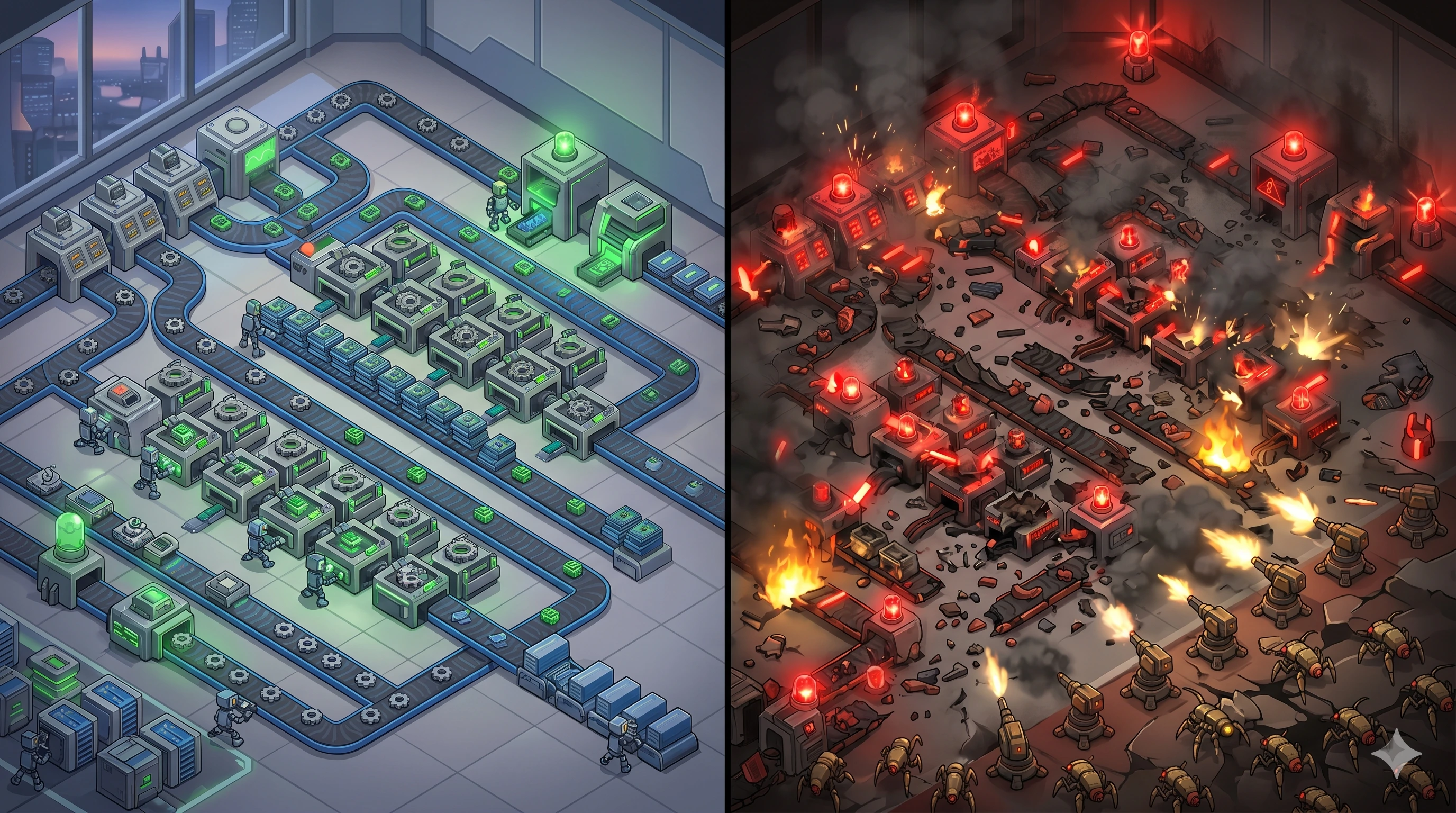
That is why Factorio can feel like two different games. With enemies active, expansion has teeth. Pollution, defenses, ammo supply, perimeter planning, and production gaps all matter. With enemies off, the same core systems become much closer to a meditation on flow. You still solve serious logistics problems, but the game stops making every rebuild feel like a risk.
This is the first split to understand when choosing chill factory games:
Complexity is not the enemy. Urgency is.
Shapez is relaxing because it strips away the usual survival frame. You cut, rotate, paint, stack, and route shapes without worrying about enemies, hunger, morale, or collapse. Shapez 2 keeps that clean logic but makes it bigger and more modular. The tradeoff is that both games are abstract. If you need a world to inhabit, not just a system to solve, they may feel too sterile.
Satisfactory relaxes in a different way. It keeps the factory fantasy physical and spacious: first-person movement, vertical construction, exploration, and big machines placed by hand. It fits players who want to walk through the thing they built. The friction is that 3D layouts can become harder to read, especially when belts, lifts, floors, and pipes start stacking on top of each other.
Both approaches can be relaxing. One removes the world so the puzzle stays clean. The other gives you a world so the factory feels like a place.
Enemy pressure changes the whole mood
Combat does not simply make factory games harder. It changes the kind of attention they demand.
In a pure automation loop, a mistake usually creates inefficiency. Your line backs up. A machine starves. A belt is too slow. That kind of problem invites tinkering.
In a combat-driven loop, a mistake can create exposure. Your defenses lack ammo. Your walls are thin. Your power grid is unstable. Now the problem is not only messy. It is dangerous.
That difference matters because relaxation depends on emotional safety. A game can be deep, demanding, and still calm if mistakes feel fixable. It becomes stressful when every messy corner feels like it might punish you.
Mindustry is a great example of a factory-adjacent game that is clever but not mainly relaxing. Its resource transport and tower defense are fused together. Belts and production lines are not just there to scale output; they are part of your survival structure. That makes it satisfying if you want logistics under pressure. It is not the best fit if your goal is to reorganize a belt bus for an hour with no one bothering you.
The Riftbreaker pushes further toward action and wave defense. Production chains matter, but so do mech combat, hostile creatures, and escalating attacks. For players who want automation with a pulse, that works. For players looking for low-stress factory games, it is probably the wrong mood.
The mistake is assuming enemy pressure can be ignored because "the factory part is still there." It cannot. Even if combat is only one system among many, it changes the session rhythm.
You stop asking:
"How can I make this cleaner?"
And start asking:
"What breaks if I spend too long fixing this?"
That is not bad design. It is just not relaxing design.
Throughput pressure is best when you choose it
Factory games are built on throughput. More ore, more plates, more components, more science, more output. That loop can be calming because it creates a clear sense of progress.
The stress question is whether throughput feels like your goal or the game's demand.
Production Line is built around efficiency optimization in a car factory. Sequencing, output, bottlenecks, and factory-floor flow are the point. That can be satisfying, but it is not the same kind of relaxation as slowly beautifying a Satisfactory base or solving a Shapez line at your own pace. If numbers and bottlenecks already feel like work, Production Line may keep poking that nerve.
Captain of Industry is even heavier. It connects mining, refining, logistics, terrain excavation, farming, shipping, and colony needs. It absolutely belongs in the wider factory conversation, but it is not a casual decompression pick. The appeal is watching a serious industrial system interlock across many layers. The cost is mental load.
Factory Town makes throughput feel softer. Villagers, conveyors, magic transport, and a colorful economy give it a lower-pressure rhythm. You still build production chains, but the tone feels closer to steady growth than industrial emergency. It fits players who want automation with a cozy settlement mood. The limitation is that players who crave hard optimization may find it too gentle.
Factory Town Idle goes lighter again. Its idle structure turns production growth into incremental scaling. That makes it useful for players who enjoy factory progression but do not always want full spatial planning. The tradeoff is obvious: it is less hands-on than a traditional factory sim.
The calmest factory games still let you chase ratios. They just do not make perfect ratios feel mandatory every second.
You can optimize. You can also say, "good enough," and keep building.
Complexity is fine when the pacing is kind
A factory game can be complex and still relaxing if it introduces that complexity at a pace that lets you build confidence.
Stress spikes when too many mental models arrive at once: new resources, new terrain problems, new logistics types, new enemies, new machines, new failure states. At some point, you are not expanding anymore. You are triaging.
Autonauts is a useful example. It looks cozy, and in many ways it is. You teach robots routines, automate colony tasks, and gradually offload work. It fits players who enjoy scripting behavior and watching small systems become self-sufficient. But its relaxation depends on your tolerance for programming-style thinking. If writing and debugging bot routines feels like work, the cute presentation will not fully hide that.
Dyson Sphere Program has the opposite shape. It starts with familiar automation logic, then expands toward planetary and interstellar logistics. For some players, that scale is the dream: a grand sci-fi production network that grows from local belts into solar-system planning. For others, the jump in scale can turn a calm factory into a map-spanning obligation.
Foundry sits in a middle lane. Its voxel world and first-person automation make it approachable if you like modular construction and sandbox building. It gives factory planning a block-building grammar. The tradeoff is that too much open space can become decision clutter. If you relax through constraints, the freedom may slow you down instead of freeing you.
Techtonica adds underground exploration to conveyor-based automation. That gives it more mystery and progression than a pure layout game. It fits players who want discovery attached to factory growth. It is only partly a relaxation pick, though, because exploration changes the focus. The factory is not the only thing asking for attention.
The lesson is simple: complexity does not ruin relaxation. Bad pacing does.
A complex system feels calm when the game lets you understand one layer before handing you the next one.
Rebuilding has to feel safe
This might be the most important part: relaxing factory games make mistakes feel reversible.
They do not always need a literal undo button. They need a loop where tearing down, rerouting, rebuilding, and improving does not feel like punishment.
If fixing a bad layout takes five minutes, experimentation feels safe. If fixing it takes three hours, planning becomes defensive. You start trying to avoid mistakes instead of playing with the system.
Shapez is excellent here because the abstraction keeps rebuilding clean. Bad line? Delete it. Try again. The cost is low enough that experimentation becomes the main loop.
Satisfactory can also be forgiving, but in a different way. Build freedom, vertical construction, and open terrain give you room to solve around earlier messes. The main friction is readability. A bad 3D layout can become physically awkward before it becomes mathematically wrong.
Factorio is harsher, but powerful for players who enjoy refactoring. Blueprints, trains, modules, and scalable logistics reward long-term planning. With enemies off, rebuilding can become the calmest part of the game. With enemies on, the same rebuild can feel like opening the hood of a moving car.
Captain of Industry is where the undo question gets dangerous. Terrain, resource flows, heavy logistics, and settlement needs all interact. A mistake can echo through the whole industrial base. That is compelling if you want consequence. It is not ideal if you want a low-stress evening.
Before choosing a factory game, ask this:
When I build badly, does the game invite me to fix it?
If the answer is no, it probably will not feel relaxing for long.
Presentation quietly controls stress
Factory games are often judged by depth, but presentation shapes the mood more than people admit.
Minimalist games like Shapez and Shapez 2 reduce emotional noise. There are no sick citizens, grim survival meters, or moral crises. The whole screen tells you one thing: solve the pattern. That makes them strong picks for players who want factory logic without the usual industrial weight.
Cozy games like Factory Town, Autonauts, and Oddsparks soften repetition with charm. Oddsparks is a useful modern example: forgiving pacing, adjustable challenge, creature helpers carrying the grunt work, and a presentation that makes logistics feel playful instead of punitive. The systems still matter, but the world does not feel hostile. A bottleneck feels like a chore to tidy, not proof that the whole run is falling apart.
First-person factory games such as Satisfactory, Foundry, and Techtonica create calm through presence. Walking through a factory, hearing machines run, seeing belts move at eye level, and building vertically can make automation feel architectural. The tradeoff is spatial friction. A top-down view reveals problems quickly. A first-person view can hide them behind walls, floors, cliffs, and distance.
Then there are games that look clean but are not really built for calm. Mindustry is readable, but its tower-defense structure keeps pressure close. Production Line has a clean industrial focus, but its efficiency demands can make the session feel managerial. These can be excellent games. They are just not the safest answer when someone asks for a relaxing factory game.
Relaxation is not only about mechanics. It is about what the game makes a problem feel like.
Is the bottleneck a puzzle?
A chore?
A threat?
A failure?
That emotional framing changes everything.
How to choose the least stressful factory game for you
Use the source of stress, not the genre label, to choose.
If combat pressure is the problem, start with Shapez, Shapez 2, Factory Town, or Satisfactory. Factorio can work too, but only if you deliberately remove the pressure that makes it tense.
If abstract puzzles calm you down, Shapez is the cleanest recommendation. Pick Shapez 2 if you want the same logic at a larger scale. Avoid them if you need characters, scenery, or a strong sense of place.
If you want a cozy economy instead of an industrial machine, Factory Town is the better fit. Oddsparks is the modern creature-powered alternative if you want automation with adventure texture and light combat that stays soft. Autonauts can also work if teaching robots routines sounds satisfying instead of tedious.
If you want to live inside the factory, Satisfactory is the obvious anchor. Foundry is a good alternative if voxel construction appeals to you. Techtonica fits when underground exploration and progression are part of the appeal.
If you like pressure but want it to be structured, Mindustry and The Riftbreaker make more sense than the calmer picks. Just do not mistake them for decompression games.
If you want deep industrial consequence, Captain of Industry and Production Line are valid choices. They are not the first stops for factory games without stress. They are for players who relax by managing complexity, not avoiding it.
A simple way to think about it
Here is the cleanest split:
- Pure calm automation: Shapez, Shapez 2
- Cozy production growth: Factory Town, Factory Town Idle, Autonauts, Oddsparks
- Immersive first-person building: Satisfactory, Foundry, Techtonica
- Big-scale sci-fi logistics: Dyson Sphere Program
- Deep industrial management: Captain of Industry, Production Line
- Automation under pressure: Mindustry, The Riftbreaker
- Flexible depending on settings: Factorio
That last category is important. Some games change dramatically based on settings or playstyle. Factorio with enemies off is not the same emotional experience as Factorio with expanding biters and pollution pressure. The factory systems are the same, but the mood is not.
A small setup upgrade for long factory sessions
Relaxed automation still means long stretches of reading belts, menus, ratios, and layouts. A monitor lamp is a practical fit for evening factory sessions because it improves desk lighting without adding more screen glare.
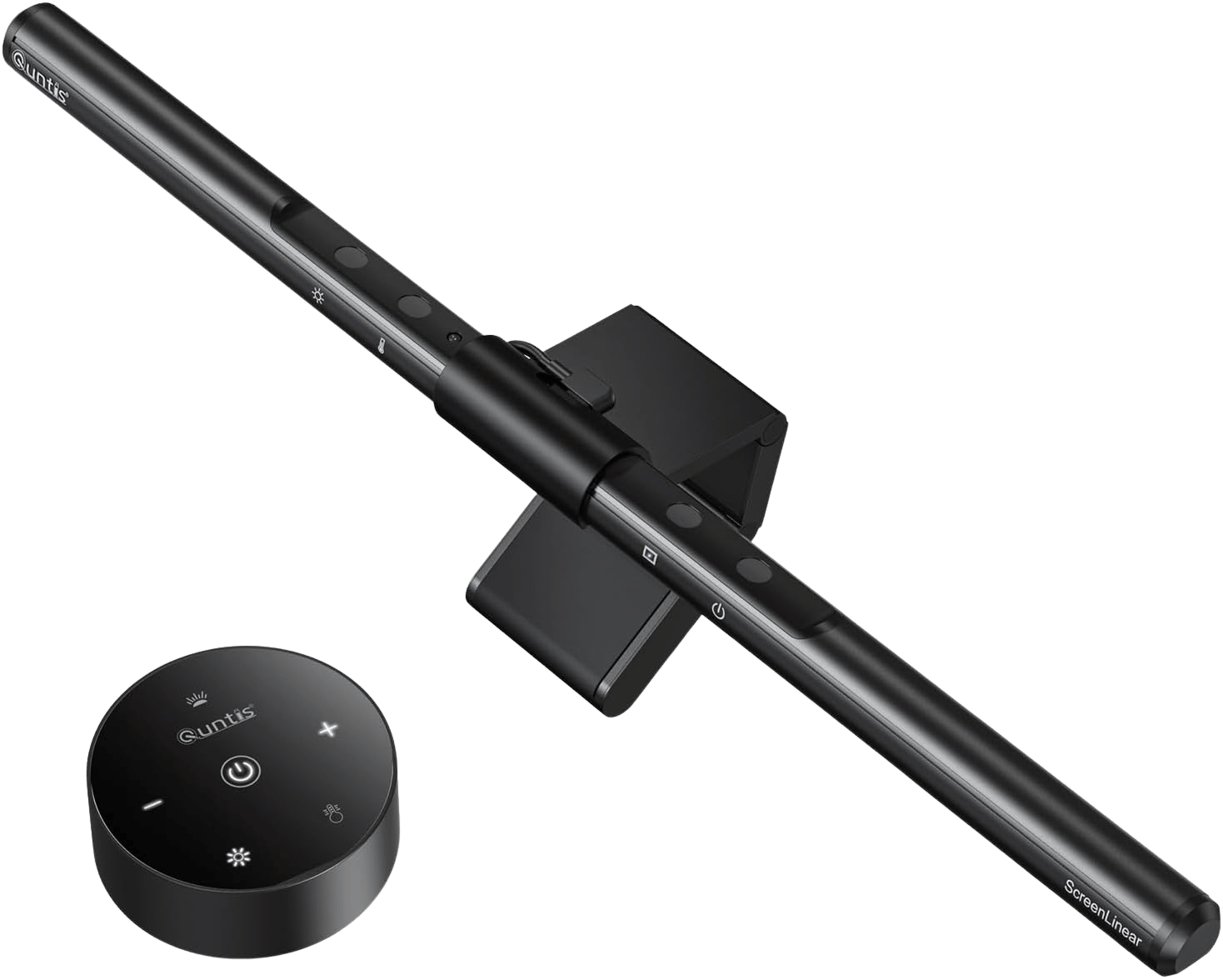
Quntis Computer Monitor Lamp
Reduces glare and eye strain during long sessions—auto-dimming, clip-on design.
FAQ
Are relaxing factory games always easy?
No. They are usually forgiving, readable, or low-pressure. A game can have deep systems and still feel calm if it lets you pause, rebuild, and optimize at your own pace.
Is Factorio a relaxing factory game?
It can be, but not for everyone by default. Combat pressure is a major part of its stress profile. Turning enemies off shifts the focus toward logistics, scaling, trains, blueprints, and refactoring, which can feel much more meditative.
What is the best starting point for factory games without stress?
Shapez is the cleanest starting point if you want pure automation logic. Factory Town or Oddsparks is better if you want a warmer setting. Satisfactory is the better pick if first-person building and large 3D factories sound relaxing.
Are first-person factory games more relaxing than top-down ones?
Sometimes. Satisfactory, Foundry, and Techtonica can feel more immersive and less spreadsheet-like. The tradeoff is that 3D layouts can become harder to inspect and fix than top-down belt systems.
Which factory games should stress-sensitive players be careful with?
Be careful with Mindustry, The Riftbreaker, Captain of Industry, and Production Line. They can be excellent, but their pressure comes from combat, wave defense, heavy systems, or efficiency management.
What makes a factory game cozy?
Usually tone, pacing, and safety. Cozy factory games make problems feel fixable. They give you time to rebuild, avoid constant threats, and use presentation that makes repetition feel pleasant instead of punishing.
Takeaway
Relaxing factory games are not defined by simple mechanics. They are defined by pressure design.
The calm ones let you think, rebuild, and optimize without turning every mistake into a crisis. The stressful ones may still be brilliant, but they add urgency through combat, survival, efficiency pressure, or heavy consequence.
For calm automation, start with Shapez, Shapez 2, Factory Town, Oddsparks, or Satisfactory. Move toward Factorio, Dyson Sphere Program, Foundry, or Techtonica when you want more scale. Save Mindustry, The Riftbreaker, Captain of Industry, and Production Line for the nights when pressure sounds like the point, not the problem.