Factorio First Oil Setup: Crude Oil to Plastic
Build your first Factorio oil setup from crude to plastic, with a clear production diagram, setup order, output checks, and fixes for stalled machines.
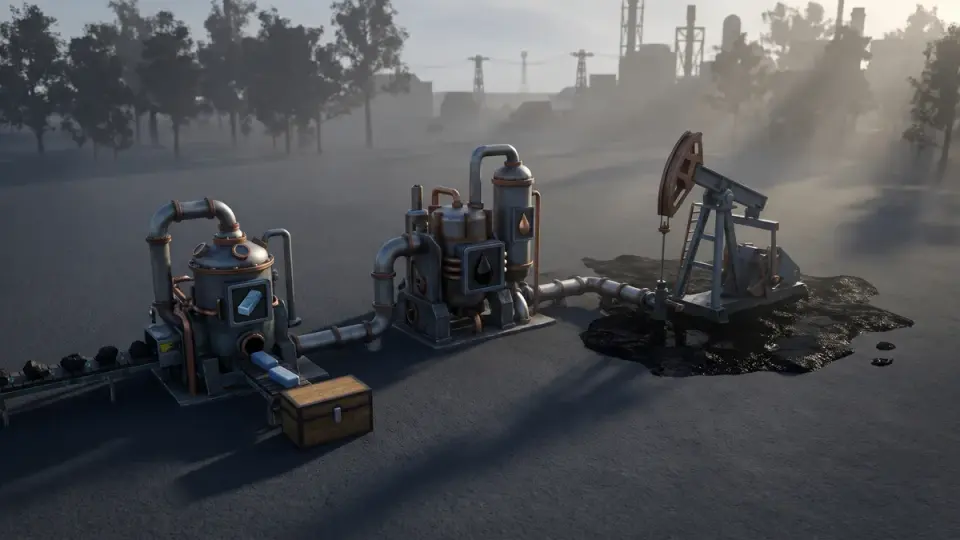
Adding another refinery will not fix a pipe connected to the wrong port. Your first Factorio oil setup needs one path you can trace: crude reaches the refinery, petroleum gas reaches the chemical plant, coal arrives, and plastic leaves. Build one pumpjack, one oil refinery, and one chemical plant, then check each handoff before you make anything bigger.
Everything here applies to the Factorio 2.0 base game on PC, unmodded. Space Age can stay installed because these early recipes work the same on Nauvis; its other planets don't matter yet. All machines are normal quality, with no modules and no beacons. The endpoint is plastic bars collecting in a chest.
The four checkpoints, in order:
- Crude oil sits inside the refinery.
- Petroleum gas sits inside the chemical plant.
- Coal sits in the chemical plant's item slot.
- Plastic bars land in the output chest.
The target for your Factorio oil setup: first plastic, not a refinery megabase
Oil is where a working starter base suddenly feels unreadable. Fluids don't show up on belts, machines have several ports, and a refinery can look busy while nothing reaches the next machine. Treat first oil as a commissioning job: connect one stage, confirm what flows out of it, then move downstream.
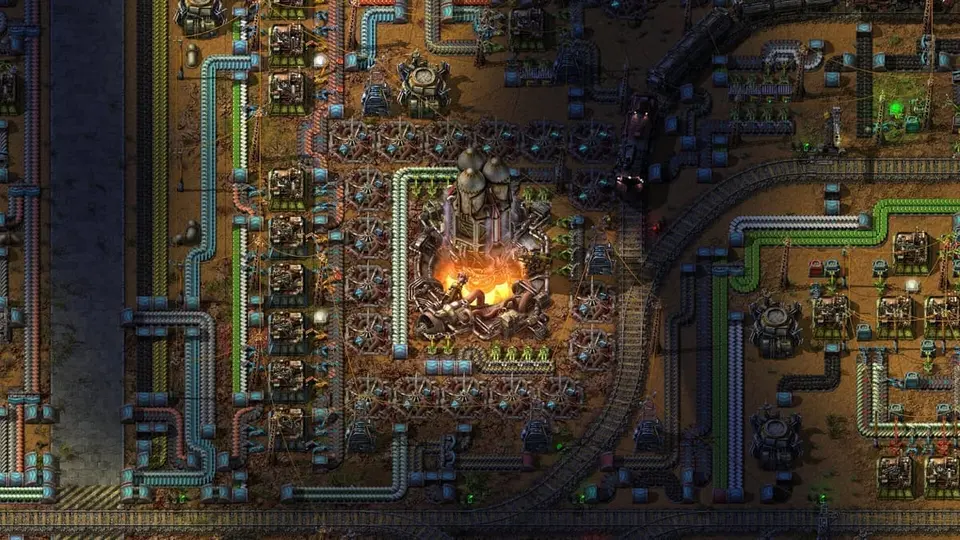
Factorio is a strategy, simulation, factory-sim game from Wube Software, and oil is the point where its extraction-and-refining side takes over from simple smelting. Before you start, you should already have red science and green science automated, steel in production, and a coal power setup with some spare capacity. If any of that is still shaky, settle your Factorio early-game priorities first. Oil will expose every weak supply line you already have.
A small chain you fully understand, making 27 plastic per minute from one pumpjack at 100% yield, is good enough for now. Advanced circuits only need a trickle at first.
Research and pack the first-oil kit
Unlock these technologies in order:
- Fluid handling, which gives you the fluid logistics basics such as pumps and storage tanks.
- Oil gathering, which unlocks the pumpjack.
- Oil processing, which unlocks the oil refinery, the chemical plant, and the Basic oil processing recipe. In 2.0 this one is a research trigger rather than a science cost: it completes once you extract crude oil, so place your pumpjack first.
- Plastics, which unlocks the Plastic bar recipe for the chemical plant.
Your starter base must already supply steel plate, iron gear wheels, electronic circuits, pipes, and stone bricks. The refinery is the expensive part. Everything else is cheap.
| Item | Qty | Cost or source | Fixed? |
|---|---|---|---|
| Pumpjack | 1 | 5 steel, 10 gears, 5 circuits, 10 pipes | Fixed |
| Oil refinery | 1 | 15 steel, 10 gears, 10 circuits, 10 pipes, 10 bricks | Fixed |
| Chemical plant | 1 | 5 steel, 5 gears, 5 circuits, 5 pipes | Fixed |
| Inserters | 2 | Coal in, plastic out | Fixed |
| Output chest | 1 | Iron chest is fine | Fixed |
| Pipes / pipe-to-ground | Varies | Field to refinery to plant | Layout-dependent |
| Electric poles | Varies | Base to oil field | Layout-dependent |
| Coal belt or chest | Varies | Coal route to the plant | Layout-dependent |
Pack extra pipes and poles. Oil fields rarely sit next to your smelters, and the distance sets how much transport material you need. The machine count stays the same either way.
Read the crude-to-plastic diagram: Factorio basic oil processing
Basic oil processing turns crude oil into petroleum gas and nothing else. That makes it the cleanest first chain: you route one output, with no heavy oil or light oil to store or crack.
OIL FIELD
   │
[PUMPJACK] ── output port
   │  pipe: CRUDE OIL
   ▼
[OIL REFINERY]  recipe: Basic oil processing
   │  input: crude port   output: petroleum gas port
   │  pipe: PETROLEUM GAS
   ▼
[CHEMICAL PLANT]  recipe: Plastic bar
   ▲  fluid input: petroleum gas (pipe)
   │
   │  item input (inserter) ◄── COAL belt or chest
   │
   └─► item output (inserter) ──► PLASTIC chest
The diagram has two kinds of connection. Pipes carry fluids and attach only to a machine's fluid ports. Inserters carry items, can grab from any edge of the machine, and don't care about port positions. Coal and plastic travel by inserter; crude and petroleum travel by pipe.
The recipes are:
- Basic oil processing: 100 crude oil → 45 petroleum gas, 5 seconds, in the oil refinery (crafting speed 1).
- Plastic bar: 20 petroleum gas + 1 coal → 2 plastic bars, 1 second, in the chemical plant (crafting speed 1).
Build upstream first: oil field to Factorio petroleum gas
Start at the oil field and work toward the plastic. Each step below ends with something you can see.
Place and power the pumpjack
- Hover over a crude oil patch and note its Yield percentage. A pumpjack makes 10 crude oil per second for each 100% of yield.
- Place the pumpjack on the patch. Press R to rotate it until its single output port faces your refinery site.
- Run electric poles out from the base. The pumpjack draws 90 kW.
Pass condition: the pumpjack status reads Working, hovering over it shows a production rate, and Oil processing completes.
Place and orient the refinery
The refinery is a 5×5 building with two input ports on one side and three output ports on the other. Before you pipe anything, set its recipe to Basic oil processing. Then turn on Alt mode, which overlays arrows on each fluid port and shows which ones the recipe actually uses.
- Click the refinery and choose Basic oil processing.
- Rotate with R, or mirror with H or V, until the active crude input faces the pumpjack.
- Lay pipe from the pumpjack's output port to that input. A straight pipe or a pipe-to-ground pair is enough at these volumes.
Pass condition: opening the refinery shows crude oil in its input. In 2.0, if you join two different fluids, the game blocks the connection and warns you, so a refused pipe usually means you've reached the wrong port.
Connect the petroleum output
The refinery draws 420 kW, so check your power headroom before you add it. Pipe from the petroleum gas output port, the one Alt mode marks as active, toward where the chemical plant will go.
Pass condition: the refinery shows petroleum gas in its output, and the pipe carries it when you hover. If the pipe has nowhere to go yet, the refinery fills up and stops with Output full. That's expected at this stage.
Add coal and start Factorio plastic production
The chemical plant is where a fluid line and an item line meet. Most first-oil confusion happens here, because the plant needs both inputs before it does anything.
- Place the chemical plant and set its recipe to Plastic bar.
- Turn on Alt mode, then rotate or flip the plant until a fluid input port faces the petroleum pipe. Connect it.
- Run coal to the plant. A branch off your coal belt works, and so does a chest you top up by hand for the first test. Place an inserter that moves coal from the belt or chest into the plant.
- On another side, place an inserter that takes from the plant and drops into an empty iron chest.
- Make sure both inserters and the plant (210 kW) are on the power network.
Pass condition: plastic bars appear in the chest. That's the first real proof that the whole chain works, from oil field to finished product.
Worked example: one pumpjack, one refinery, one plant
The yield below is an example value. Use your own pumpjack's yield to redo the math.
Inputs: one pumpjack on a field with an example yield of 100%, one refinery on Basic oil processing, one chemical plant on Plastic bar, plenty of coal, and an empty iron chest.
Step 1, crude supply. 100% yield × 10 crude/s = 10 crude oil per second.
Step 2, refinery. At full speed the refinery uses 100 crude every 5 s, which is 20 crude/s, and makes 45 petroleum every 5 s, which is 9 petroleum/s. With only 10 crude/s arriving, it runs at 10 ÷ 20 = 50% of capacity and makes 4.5 petroleum gas per second.
Step 3, chemical plant. At full speed the plant uses 20 petroleum per second and makes 2 plastic per second. With 4.5 petroleum/s arriving, it runs at 4.5 ÷ 20 = 22.5% of capacity.
Step 4, output. 2 plastic/s × 0.225 = 0.45 plastic per second, or 27 plastic per minute. The plant uses coal at 1/s × 0.225 = 0.225 coal per second, about 13.5 per minute.
Step 5, power. 90 + 420 + 210 = 720 kW for the three machines, plus a few kW for the inserters. That's less than one steam engine's 900 kW, but only if your existing coal power setup actually has that much spare.
Result and decision: the chemical plant spends most of its time waiting. That isn't a fault; the pumpjack sets the pace. A second chemical plant would add nothing here, because crude supply is the constraint. If you need more plastic, add pumpjacks first. Two pumpjacks at 100% would fill this refinery at 20 crude/s, and one full refinery (9 petroleum/s) still covers only 45% of one plant.
The two inserters handle this load easily: the plant only needs 0.225 coal in and 0.45 plastic out per second.
Commission the chain: Factorio refinery not working checks
First plastic output checks
A stopped machine tells you something. Hover over it and read the status before you change anything. Find the first stage in the chain that fails its check, and fix only that stage.
| Symptom | Check | Fix | Retest |
|---|---|---|---|
| No crude anywhere | Pumpjack status | Power it; confirm it sits on oil | Crude in pipe |
| Crude in, no petroleum | Refinery recipe, power | Set Basic oil processing | Petroleum in output |
| Petroleum at refinery, none at plant | Alt-mode ports | Repipe to active output and input | Gas inside plant |
| Gas in plant, no coal | Coal inserter, belt | Feed coal; power inserter | Coal in slot |
| Machines slow, flickering | Power graph | Add steam engine or boiler | No Low power |
| Plant reads Output full | Chest or belt | Empty chest; clear belt | Plastic resumes |
The classic case: the refinery is full of petroleum, but the plastic plant still reports a fluid ingredient shortage. That almost always means the pipe left from a port the recipe doesn't use, or entered the plant on its output side. Alt mode settles it in seconds.
Another common one is coal sitting on a belt right next to the plant while the item slot stays empty. The inserter is facing the wrong way, has no power, or is reaching a lane the coal isn't on. Rotate it so it picks up from the belt and drops into the plant.
When waiting is normal
Two kinds of waiting aren't faults:
- Upstream-limited: the plant crafts, pauses, then crafts again, because petroleum arrives at 4.5/s and the plant can use 20/s. In the example this is 22.5% activity by design.
- Downstream-full: in the example, an iron chest (32 slots × 100 plastic = 3,200 bars) fills in about two hours at 0.45/s. Then the plant stops with Output full, petroleum backs up into the refinery, and the pumpjack goes idle. Emptying the chest restarts the whole chain.
If every machine is either working or waiting for a reason you can name, the chain is healthy.
Keep it, repair it, or expand it
Choose the smallest action that matches what you see:
- A status shows a fault (No recipe, No power, a missing fluid with full pipes upstream): repair that connection. Don't add machines.
- The plant waits for petroleum, and you want more plastic: add pumpjacks before you add refineries. Supply is the constraint.
- The refinery reads Output full with the plant idle: clear the plastic output or give it a belt.
- The plant runs near 100% and you still need more: that's when a second plant earns its place.
Before you grow it, check that the layout still reads clearly. Straight pipes, a coal branch you can follow, and open tiles around the refinery make later changes cheap. Crowding them in is one of the early-game mistakes that create expensive cleanup.
What first plastic unlocks
Plastic feeds advanced electronic circuits (2 plastic bars, 4 copper cable, 2 electronic circuits → 1 advanced circuit, 6 s), and those feed chemical science. That's the next production chain, and it needs its own copper cable and circuit supply alongside this plastic line.
Advanced oil processing comes later
Advanced oil processing is a redesign, not a quick recipe swap. It adds water as a second input and splits crude into heavy oil, light oil, and petroleum gas across three output ports. Any of those outputs can back up and stop the refinery, so cracking and storage become their own planning job. Leave it until plastic is flowing and you need more petroleum per crude.
For now, your milestone is plastic accumulating in a chest from a chain you can trace end to end. If every check above passes, keep this setup running and start on advanced circuits next.