Oxygen Not Included Early Food Guide: Fix Shortages
10 min read
Fix early food shortages in Oxygen Not Included: check calorie reserves, keep Mealwood producing, and know when it's safe to print another Duplicant.
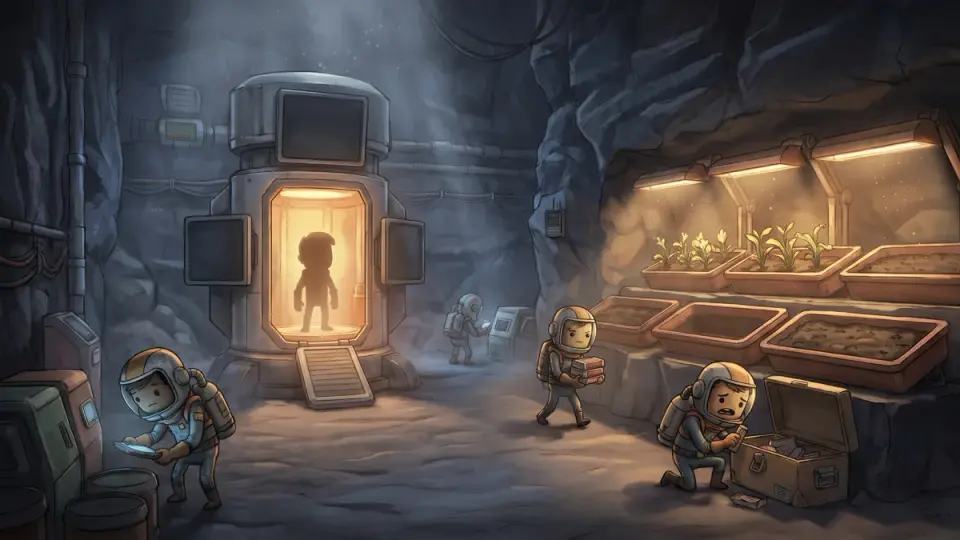
The Duplicant who could clear your farm backlog starts eating the moment they step out of the Printing Pod, long before you know whether the backlog is fixed. When your reserve is dropping, hold the print. Count the calories your crew can actually reach and eat, compare them with what the colony burns each cycle, and check whether that food lasts until the next dependable harvest.
Work through it in order: read the reserve, buy time if you need it, trace why your Mealwood is late, get the batch to the crew, and only then decide on a recruit. A food bin that looks full right after a harvest can hide an Oxygen Not Included food shortage that is already underway.
Quick take
- Reserve falling and food errands still waiting? Reject this print and clear the errands first.
- Harvest due after your food runs out? Bridge the gap with leftover Nutrient Bars, buried Muckroot, or a few Mush Bars.
- Food arriving but stock still shrinking? Plant more Mealwood before you add a mouth.
- Recurring calories cover a bigger crew and the low point holds? One recruit is reasonable.
Hold the print and read your food reserve
A reserve is food sitting in storage. A production rate is food that arrives every cycle without you doing anything special. The recruit decision needs both, and a harvest spike tells you about neither.
 View on Steam
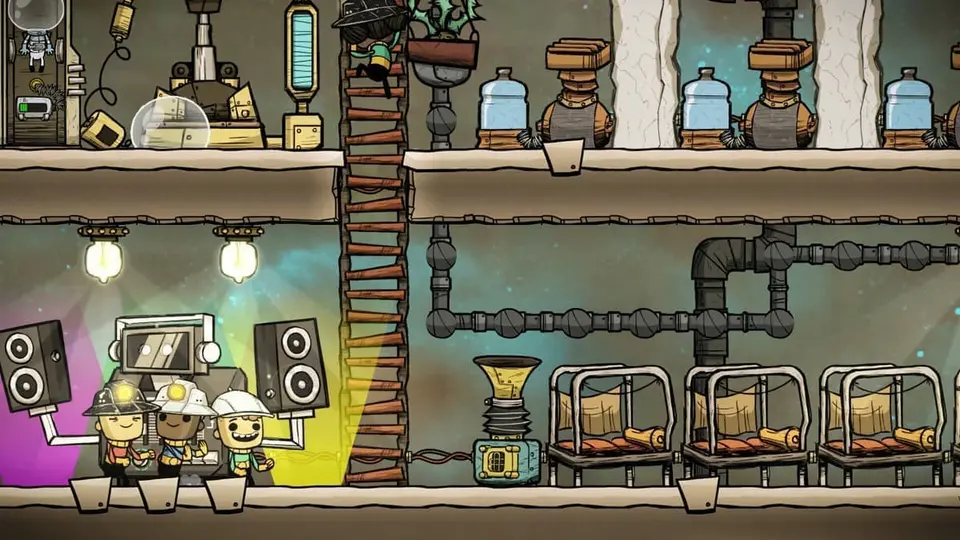
Oxygen Not Included is a dense colony sim from Klei Entertainment, and its difficulty is rated hard. Food is one of the first places that difficulty shows up. The game simulates hunger honestly, but it won't stop you from accepting a new Duplicant on the cycle your reserve peaks, and that print is one of the costliest mistakes in an early colony.
Count only food your crew can eat
Your usable reserve is smaller than everything you own. Leave these out of the count:
- Food stored somewhere a Duplicant can't path to, behind a blocked door, a missing ladder, or a flooded corridor.
- Food types a Duplicant isn't allowed to eat. Food permissions are set per Duplicant on the Consumables screen.
- Food that is close to spoiling, because it won't still be edible when you need it.
Read your colony's stored calories at the same point in each cycle, for example at the start of the work shift. If you compare a post-harvest number with a pre-harvest one, the trend lies to you.
Turn the reserve into cycles
Swap in your own numbers here. Say your colony has 9,000 reachable, permitted kcal, your crew has been eating 3,000 kcal per cycle, and your next dependable harvest is four cycles away.
At the default hunger setting, each Duplicant needs 1000 kcal per cycle, so 3,000 kcal matches a three-Duplicant crew.
- Cycles of food = reserve ÷ consumption per cycle
- 9,000 kcal ÷ 3,000 kcal per cycle = 3 cycles, before any spoilage
Three cycles of food against a harvest four cycles out means you run dry a full cycle early. Skip the recruit and bridge the gap now. A fourth Duplicant would make it worse, because 9,000 ÷ 4,000 gives about 2.25 cycles.
Buy time when the next harvest is too late
If the reserve won't reach the next harvest, use food that already exists before you cook anything. Use up any remaining starting Nutrient Bars first. On a typical Terra-style start, also dig out any Muckroot buried in the starting area, if your map has it.
Both are finite. They buy cycles, but they don't fix the rate. Once they're gone, you're back to whatever your farm produces.
Mush Bars as an emergency bridge
Mush Bars from the Microbe Musher are the fallback when you've run out of stored food. Each Mush Bar takes 75 kg of Dirt and 75 kg of Water. The Musher needs 240 W of power and a Duplicant on the Cook errand. The result is one 1 kg Mush Bar worth 800 kcal, and it's a poor-quality meal your crew will tolerate rather than enjoy. Mush Bars also carry Food Poisoning germs, so treat them as a short bridge, not a diet.
Carry the same example forward. Four cycles at 3,000 kcal per cycle needs 12,000 kcal, and you have 9,000, so you're 3,000 kcal short. That's 3,000 ÷ 800 = 3.75 bars, so you cook four. Four bars cost 300 kg of Dirt and 300 kg of Water. At 40 seconds per bar with zero cuisine skill and no Lit Workspace, that's about 160 seconds of cooking time.
The catch is the Dirt. Mealwood also eats Dirt, so every Mush Bar burns fuel your farm needs:
- One bar's 75 kg would fertilize one Mealwood plant for 7.5 cycles.
- A 15-plant farm uses 150 kg of Dirt per cycle.
- Four bars therefore cost that farm two cycles of fertilizer.
Cook only the bars that close the gap, and keep your Dirt stock ahead of the farm.
Find out why your Mealwood is late
Mealwood farming is the repeatable supply. When it falls behind, click a stalled plant and compare its status with a mature plant that's waiting to be harvested. The status tells you which of three problems you have.
Growth has stopped
A Mealwood plant only grows inside its conditions:
- a temperature range of 10 °C to 30 °C (50 °F to 86 °F)
- air pressure between 150 g and 10 kg
- an atmosphere of Oxygen, Polluted Oxygen, or Carbon Dioxide
If the status flags pressure or atmosphere, the plant is sitting in a gas pocket it can't use or in near-vacuum. Seal the room or move the plot. If temperature is the blocker, that's a cooling problem rather than a food problem, so work through my Oxygen Not Included heat management guide. To retest, the plant's status should read as growing again by the next cycle.
Dirt isn't arriving
Domesticated Mealwood grows in a Planter Box, a Farm Tile, or a Hydroponic Farm, and it needs 10 kg of Dirt per cycle. When that delivery stops, growth stops with it.
Check three things in order:
- Is there Dirt in storage?
- Can a Duplicant reach both the Dirt and the plot?
- Is the Supply errand getting picked up?
To retest, watch for a delivery to land in the plot and the plant to start growing again.
The plant is ripe but nobody harvests it
A mature plant waiting on a harvest is food you've already grown and can't eat. One domesticated Mealwood plant produces one Meal Lice worth 600 kcal every 3 cycles, and only if the harvest errand happens right away. Every cycle a ripe plant sits waiting is a cycle it isn't regrowing.
Confirm the plant is set to harvest when ready. Then treat it as an errand problem and fix it in the next section.
Get the next batch to the crew
A harvest only counts once the food reaches storage your crew can eat from. When food errands are waiting, work down this list and change one thing at a time:
- Access. Make sure a Duplicant can physically reach the farm, the Dirt, and the food storage. One missing ladder can stall an entire food chain.
- The right worker. Find a Duplicant who has Farming enabled. Give that job a higher priority on the Priorities screen than their other work.
- Competing work. Pause or deprioritize digging and construction for a cycle so the food errands win.
- Storage. Check that the Storing errand moves Meal Lice into a Ration Box or Refrigerator rather than leaving it on the floor.
Do the jobs in this order before you add any farm tiles:
- Harvest the ripe plants.
- Deliver Dirt to stalled plots.
- Store the harvest.
New tiles add more Dirt deliveries to the same backlog. Expansion only helps once the crew is keeping up with the plots you already have.
When food arrives but the stock still falls
If harvests are reaching storage and the reserve still shrinks, find out where the food goes. There are three common leaks:
- Consumption. The crew is simply eating more than the farm makes. This is a production gap, covered in the next section.
- Spoilage. Food left at room temperature rots. A Refrigerator, or a cold storage spot, slows that loss.
- Locked food. Some food is stored out of reach or is forbidden on the Consumables screen. It shows up in your total but feeds nobody.
To retest, change one food priority or setting, then watch whether the next batch actually reaches the crew before you touch anything else.
Watch the reserve through the next harvests
The number that matters is the low point just before each batch, not the peak right after it. Mealwood runs on a 3-cycle rhythm, so record the pre-harvest low across two or three harvests.
What the trend means:
- Rising or steady lows. The colony's food supply is holding.
- Falling lows. You're running a deficit, however good each harvest looks.
If your errands are clearing and the lows still drop, you need more reliable production before you need more workers.
Here is the farm math, based on the documented yield. At 600 kcal every 3 cycles, one plant averages 200 kcal per cycle. At the default hunger setting, that means:
- one Duplicant needs five plants
- a three-Duplicant crew needs 15 plants
Those figures assume prompt harvests, so a couple of spare plants is good enough insurance. You don't need a perfect ratio.
The Microbe Musher you built for Mush Bars can also stretch the same harvest. Liceloaf turns 2 Meal Lice (1,200 kcal) and 50 kg of Water into 1,700 kcal, about 42% more food from the same plants. Cooked that way, each plant averages about 283 kcal per cycle, so a three-Duplicant crew needs 11 plants instead of 15. Liceloaf costs Water and a Cook errand instead of Dirt, so it eases a shortage without pulling fertilizer from the farm.
If Mush Bars or the last Nutrient Bars are holding the lows up, the colony isn't stable yet. It's coasting on emergency food.
Decide whether to print one more Duplicant
Whether to print another Duplicant comes down to calories per cycle, measured with the next mouth included.
Wait if any of these are true:
- the lows are falling
- a one-off stockpile or emergency Mush Bars are carrying the reserve
- food errands only finish when you override priorities
Consider one recruit only if all of these are true:
- recurring Mealwood output already covers the larger crew
- the edible buffer outlasts the gap between batches
- food work gets done under normal priorities
Going from three Duplicants to four raises the target from 15 plants to 20. It also adds another 1000 kcal per cycle to your buffer math. Rerun the reserve check from the first section with that figure before you accept.
Use this check at every Printing Pod offer.
Can you feed another Duplicant?
Food is only half of the expansion question. Before you accept a new Duplicant, troubleshoot early oxygen before expanding, because a fourth set of lungs strains your air supply too.
If you're on the fence, wait. Rejecting a print costs you one candidate, while accepting one into a shrinking food supply puts every Duplicant in the colony at risk. Fix the errands, watch the low point hold through the next harvests, and the next good recruit will still be worth printing.