The Wandering Village Review: A City Builder Where Survival Depends on Your Colossus
Our review of The Wandering Village tests Onbu’s trust and Hornblower commands, biome-locked farms, poison logistics, and whether its Ghibli-inspired settlement on a giant creature is a satisfying city builder.
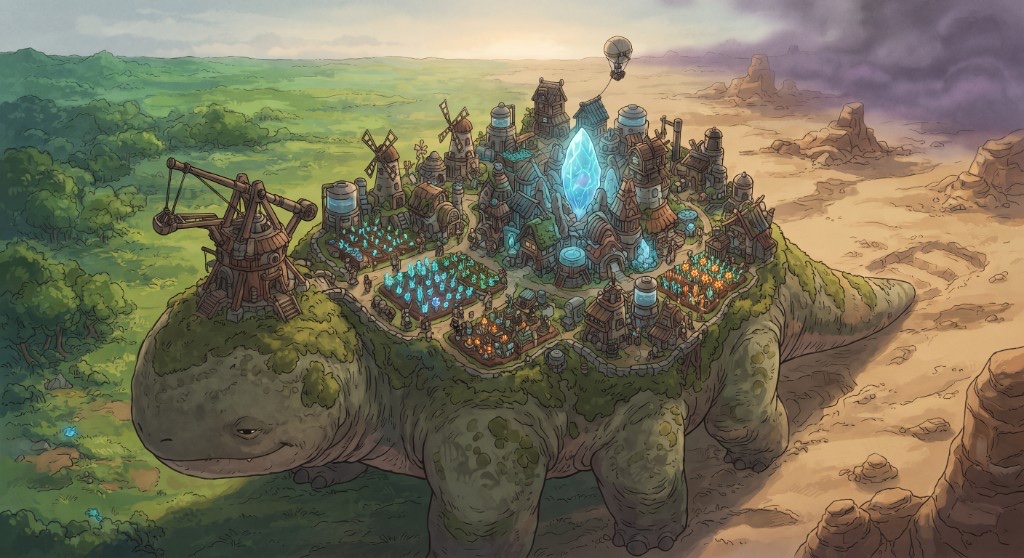
The Wandering Village puts the entire city on Onbu, a colossal host walking a spore-choked world. This review is about whether that premise becomes a real management game: not just housing and farms, but a trust meter, biome-locked production, and a poison layer that can shut the workforce down mid-crossing.
The presentation does a lot of that selling before the systems do. Hand-drawn 2D villagers and buildings sit on a 3D creature, in a painterly style Stray Fawn has tied to Studio Ghibli and Moebius. NukeTan’s folk-tinged soundtrack keeps the journey melancholic rather than frantic. That mood is a genuine strength. It is also why some players will expect a cozy sandbox, then hit dry Air Wells, ignored Hornblower orders, and Decontaminators they did not research in time.
Quick take
Best for: Players who like settlement management with a second, living economy on top of the village.
Main strength: Onbu’s trust, hunger, and poison stats turn expansion into a relationship, not a zoning exercise.
Main weakness: Biome shifts and a bounded back punish players who want one permanent, highly optimized layout.
Verdict: A focused, medium-difficulty city builder. It works when you treat the Hornblower, the Feeding Trebuchet, and crop swaps as the strategy, not as interruptions.
Onbu’s trust is the command layer
Onbu is not scenery. Health, hunger, sleepiness, poison, and trust sit beside the village’s own needs, and the Hornblower is how you ask the creature to walk, run, sleep, eat, or turn at a fork.
Those orders are suggestions. Trust rises when you launch mushroom balls from the Feeding Trebuchet, pet or treat Onbu through the Onbu Doctor, and keep it healthy. Trust falls when you starve it, let poison climb, or install extractive buildings such as a Feeding Pump or Deep Quarry. Low trust means ignored commands and, later, Onbu shaking weak buildings off its back.
That is the real expansion cost. A larger village can staff a Mycologist, an Onbu Kitchen, and an Onbu Doctor, which is how you stay in control of the route. The same growth also makes it easier to neglect the host while you chase housing and research. The interesting question is not whether you can grow. It is whether Onbu will still sprint through a toxic stretch because it trusts you.
Players who want a city that never talks back will bounce off this. The game’s identity depends on that friction.
Biomes rewrite which production still works
Jungle, desert, mountain, ocean, and ruins are not cosmetic backdrops. Humidity, temperature, and spore load change which buildings still earn their tiles.
Air Wells drink humidity. They are strong in jungle air and produce nothing in desert, so a water-stable jungle town can dry out a few map tiles later if you did not stockpile or scavenge an oasis. Heat-tolerant corn and cactus replace beets when Onbu walks onto torrid ground; cold mountain stretches push you back toward beets and wheat. The layout that looked efficient is often the wrong crop in the wrong weather.
Poison Forests add a second map-reading job. A Scavenger Hut can pull wood, mushrooms, and herbs from one, then bring poison and toxic plants home. You are not only picking a pretty route. You are deciding whether the next stretch is a water problem, a heat problem, or a contamination problem.
That is why relocation is part of play rather than busywork. The best village is the one that can change crops, idle a building, and keep moving. Players who enjoy perfecting a fixed production network will read those resets as the game taking the city away. Players who like adapting a plan will find the actual puzzle.
Logistics fail at the margins, not in a single disaster
The tone stays gentler than Frostpunk. Pressure still comes from thin reserves.
A sudden trek through a Poison Forest without enough stocked Herbalists or active Decontaminators can paralyze the workforce before Onbu finishes the crossing. Toxic plants spread across farms; villagers get sick; Decontaminators then burn Biogas from composted dung or Onbu bile you may not have researched yet. Food follows the same pattern at village scale: berry gatherers and beet farms look fine until a biome swap or a sick labor pool stops harvests, and the Kitchen and Windmill chains behind them idle.
The common mistake is to score the run by the village HUD alone. A well-fed settlement with full warehouses is still failing if Onbu is starving, poisoned, or ignoring the Hornblower. The host’s meters are the broader measure of whether the economy is sustainable.
That structure makes the game accessible if you want survival mechanics without constant crisis pop-ups. It can feel too restrained if you want Frostpunk-level emergencies. The gentler curve fits a game about preparation and symbiosis, not about winning the next ten seconds.
Who The Wandering Village is really for
The Wandering Village is a strong fit for players who want:
- A city builder whose central system is a living host, not a pile of unrelated features
- Production that you rebuild around jungle humidity, desert drought, and mountain cold
- Survival pressure that rewards Herbalists, water stores, and Onbu food before the emergency
- A slower pace with melancholic fantasy presentation
- A bounded map instead of an infinite zoning grid
It is a weaker fit if you want a purely relaxing sandbox, a massive permanent metropolis, or constant high-intensity survival. The game looks gentle. It still expects you to keep trust high, water stocked, and poison off the farms.
Verdict: is The Wandering Village worth playing?
Yes, if reorganizing farms around the next biome and keeping Onbu willing to take orders sounds better than building one ideal city and leaving it untouched.
The strongest systems all have jobs: the Hornblower and trust meter make the journey controllable, biomes make production temporary, and poison logistics make spare herbs and Decontaminator fuel matter. Together they give the game a coherent identity instead of relying only on the giant-creature screenshot.
Choose it for a medium-difficulty city builder with a distinctive resource problem and a calmer survival curve. Skip it if changing crops and rerouting Onbu feel like busywork, or if unrestricted city design is the point.
FAQ
What makes The Wandering Village different from other city builders?
You build on Onbu. Village needs share the map with the creature’s hunger, poison, sleep, and trust, and the Hornblower only works well if that relationship is healthy.
Is The Wandering Village a relaxing game?
It looks and sounds like one: hand-drawn animation, a folk-tinged score, and a measured pace. Survival still bites. Empty Air Wells in a desert, or a Poison Forest without Decontaminators, will wreck a cozy-looking town.
How important are production chains in The Wandering Village?
They are central, and they are biome-specific. Beet soup, corn, cactus, wheat, and Onbu’s mushroom kitchen all change value as the host walks, so an efficient layout is not permanently efficient.
Is The Wandering Village difficult?
Its listed difficulty is medium. The challenge is managing reserves and trust so a comfortable village does not quietly poison Onbu or lose the ability to command a sprint out of toxic air.
Who should avoid The Wandering Village?
Players who want a static city-building sandbox or a relentlessly harsh survival game. Shifting crops and a measured pressure curve will bore or disappoint those extremes.