Against the Storm Beginner Guide: What to Do in Your First 5 Settlements
A practical Against the Storm beginner guide for your first 5 settlements, covering orders, reputation, hostility, glades, resolve, blueprints, storms, and common beginner mistakes.
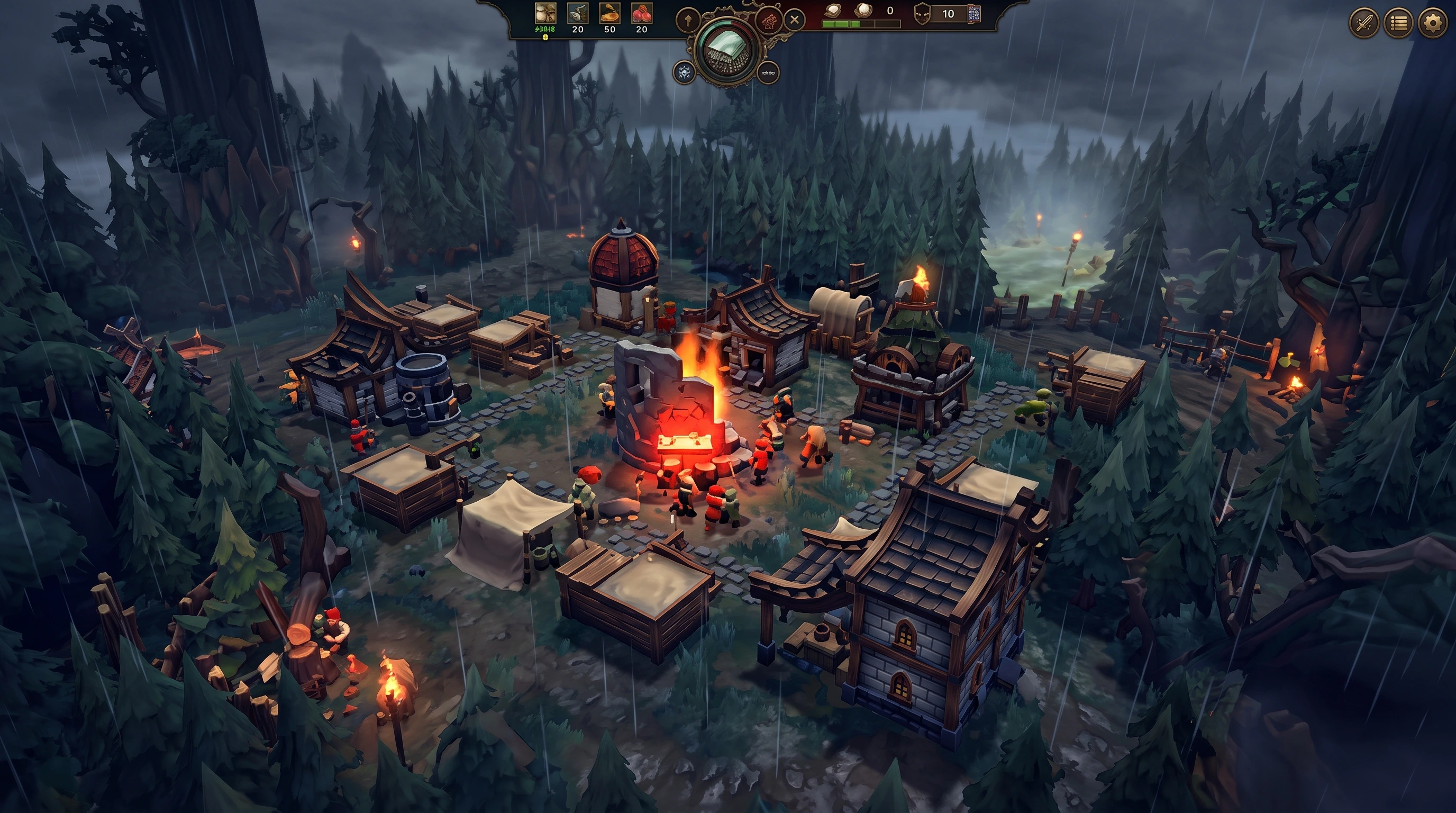
If you're new to Against the Storm, the first few settlements can feel strange. It looks like a city builder, but it does not play like a normal city builder. You are not building one perfect city forever. You are building short settlements, solving problems fast, earning Reputation, and moving on before the Queen loses patience.
That is the biggest mindset shift, and it's the one idea this whole guide is built around.
This beginner guide is for players who understand the basics but still feel lost once the first real settlement starts. You might be asking: which orders should I pick, when should I open glades, why does everyone get angry during the Storm, what should I build first, and why does the game suddenly feel harder after everything looked fine?
Good. That means you are seeing the real game.
Your first few settlements should not be about perfect play. They should teach you the loop: stabilize, pick useful orders, manage Hostility, open glades carefully, solve problems with the tools the run gives you, and push Reputation before the settlement drags on too long.
Don't try to build the perfect village. Build a village that wins.
Quick take
Your first 5 settlements should teach you this:
- start on an easy difficulty while learning
- build around the Hearth and Warehouse
- get wood, fuel, food, and basic materials stable first
- do not open too many glades too early
- learn what Hostility does before the Storm punishes you
- pick blueprints that solve your current run, not your dream run
- use Orders for early direction
- use Resolve for the final Reputation push
- treat each settlement as a run, not a forever city
If you understand those ideas, Against the Storm becomes much easier to enjoy.
What Against the Storm is really asking from you
Most city builders ask you to grow. Against the Storm asks you to finish.
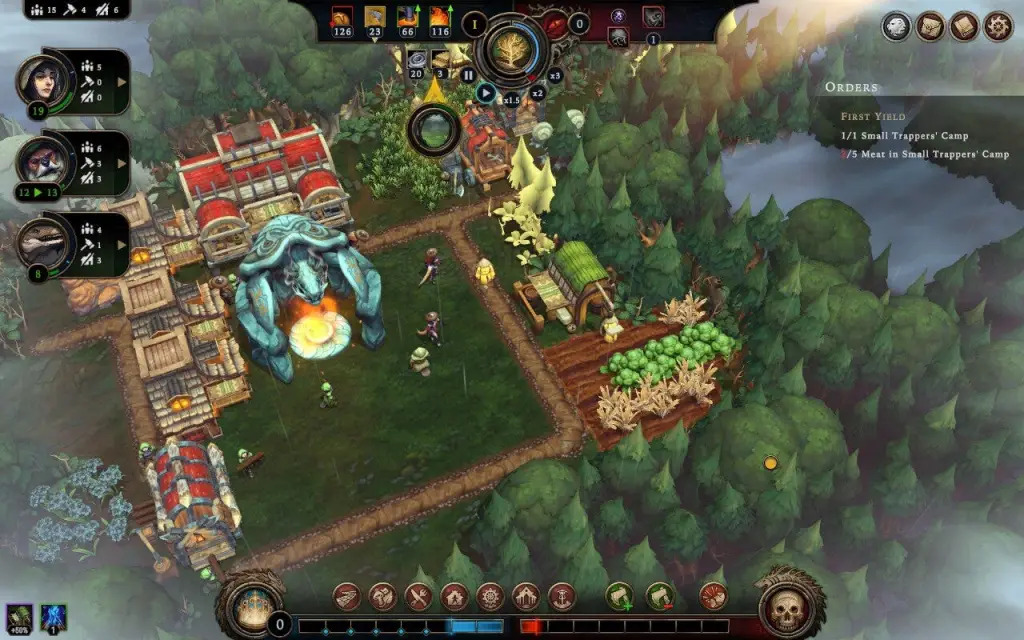
You gain Reputation from things like Orders, high Resolve, and some events or rewards. Reputation is the blue progress bar. Impatience is the red pressure bar. When Reputation fills, you win. When Impatience fills, you lose.
That means every settlement is a race. Not a fast panic race, but still a race. If you spend years making your town look nice without earning Reputation, the forest gets more dangerous, food gets tighter, and the Storm becomes more painful.
The beginner trap is playing like this is Banished, Timberborn, or Anno. In Against the Storm, a messy winning settlement is better than a beautiful settlement that never finishes.
Before you build anything
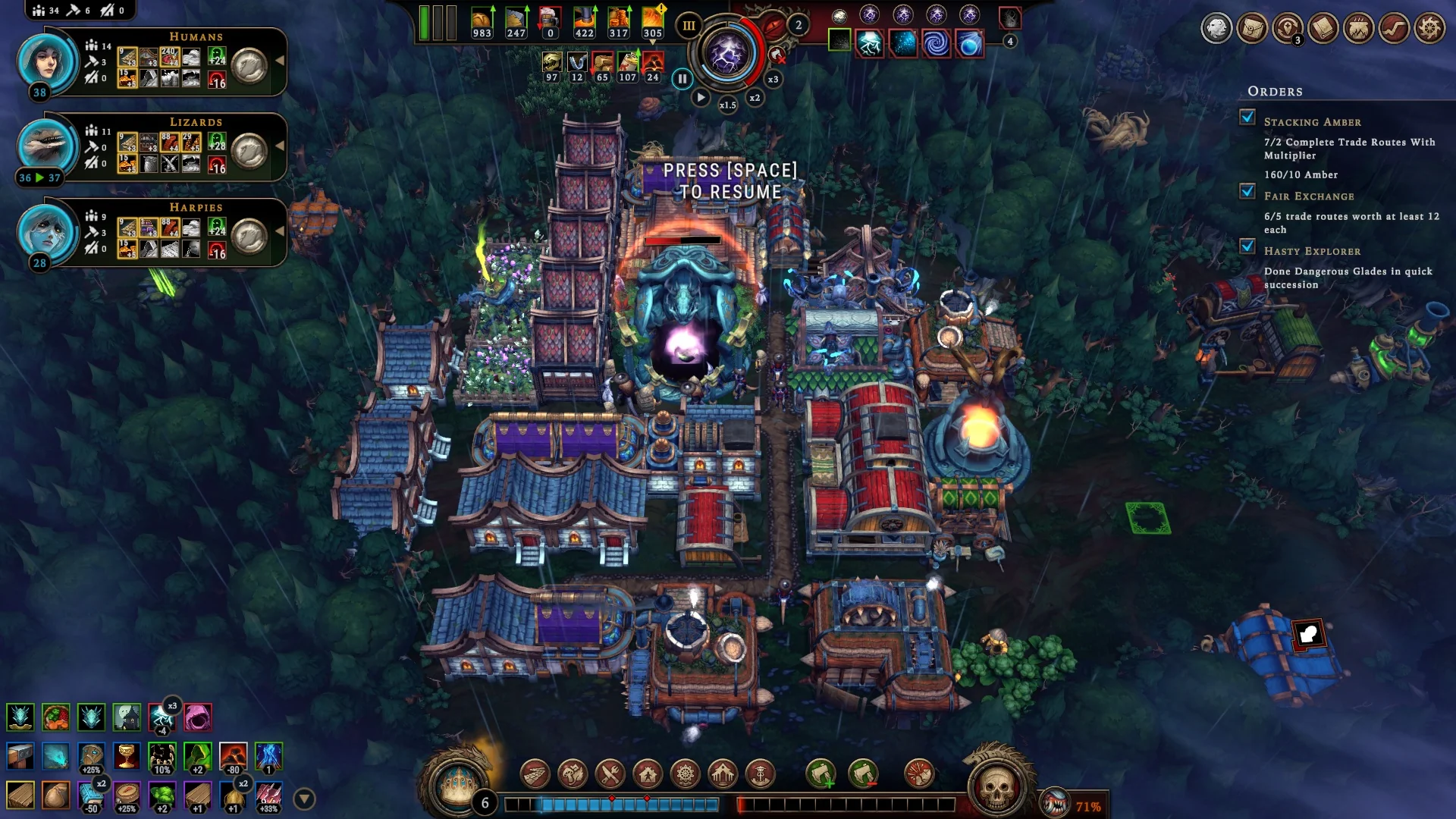
When a new settlement starts, pause for a moment. Do not instantly spam buildings. The spacebar is your best beginner tool — use it whenever you need a second to think, whether that's picking an Order, reacting to the Storm, or reading a glade event.
Look at:
- your starting species
- your starting resources
- nearby resource nodes
- available Orders
- nearby glades
- the first blueprints you are offered
- the biome resources
You do not need a perfect plan. You just need to avoid building blindly.
The first question is simple: what can this settlement actually do?
Maybe you have good grain access. Maybe you have meat and insects. Maybe you have clay. Maybe your first blueprint solves food, or building materials, or does nothing useful right now. That is the run. Play the run you got — don't force a plan from your last settlement into this one.
What your first settlement actually needs
Your early settlement does not need luxury. It needs stability.
Focus on these basics first:
- wood
- fuel
- shelter
- food
- simple building materials
- a little storage efficiency
- enough workers assigned to the right jobs
Wood is the first big resource because it feeds construction, fuel, and basic production. Your Woodcutters' Camps are important, but they are also dangerous if you forget about Hostility — more woodcutters means faster expansion, but also more pressure from the forest.
Food is the next problem. At the start, gathering is usually enough. Later, you want complex food if the run gives you a realistic path, but beginners often rush into food chains they cannot support.
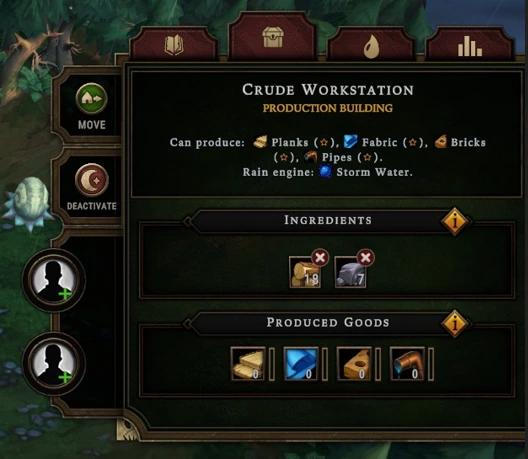
Building materials matter because many useful buildings need Planks, Fabric, and Bricks. You do not need huge production right away — just enough to keep building.
The early goal is to stop the settlement from falling apart while you start earning Reputation.
Settlement 1: learn the loop, not the meta
Play on an easy difficulty. There is no shame in that. Against the Storm has a lot of systems, and it is much better to learn them without getting crushed by higher difficulty pressure.
In your first settlement, your goals are:
- Build basic shelter.
- Keep the Hearth fueled.
- Set up Woodcutters' Camps.
- Gather nearby food.
- Make basic building materials.
- Complete easy Orders.
- Open glades slowly.
- Win without worrying about perfect efficiency.
Pay attention to how the year works. Drizzle is the easy part. Clearance is the working part. Storm is the danger part. If your settlement looks fine during Drizzle but collapses during Storm, that usually means Hostility and Resolve are the real issue — and that's a normal thing to learn the hard way once.
The first big mistake: ignoring Hostility
Hostility is one of the most important beginner systems. The forest gets angrier as the settlement grows. More years, more villagers, more opened glades, and more woodcutters can all increase pressure. During the Storm, high Hostility can push Resolve down and activate dangerous negative effects.
This is why a town can look totally fine, then suddenly everyone gets miserable when the Storm starts.
The beginner mistake is thinking, "I need more wood, so I will just add more woodcutters forever." That works until it doesn't.
Before every Storm, pause and check your Hostility. If Resolve is going to drop too low, pull some workers off Woodcutters' Camps for the Storm and put them back once it passes. That one habit saves a lot of early settlements. Woodcutters are not bad — you need them — but during the Storm they can be the difference between "everyone is fine" and "three people are about to leave."
Settlement 2: learn Orders properly
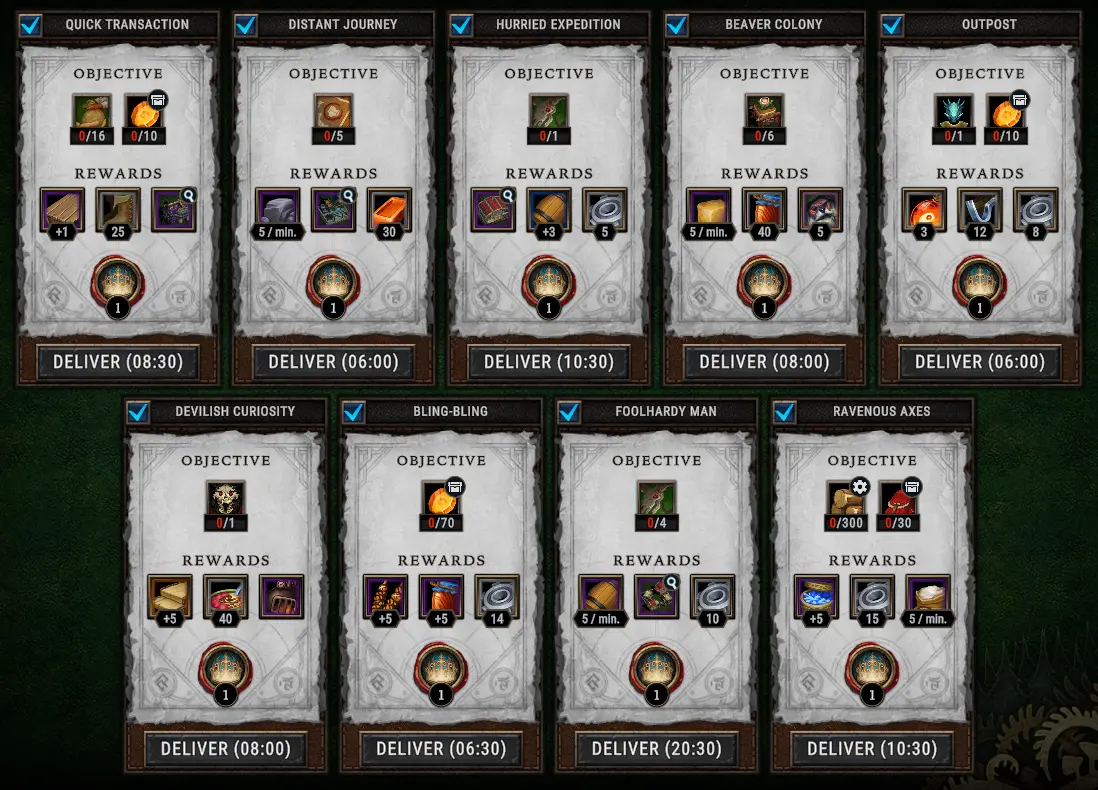
Orders are one of the best beginner tools because they give direction. When you are new, it is easy to stare at the map and ask, "What am I supposed to do now?" Orders answer that — they give you goals, rewards, and Reputation.
But do not pick Orders randomly. When choosing an Order, ask:
- Can I complete this with my current resources?
- Does this reward help my settlement now?
- Does this push me toward Reputation?
- Will this force me into a chain I cannot support?
- Is the easier Order actually better for this run?
A boring Order you can finish is often better than a fancy Order that sits unfinished for three years.
Early on, take Orders that match what you are already doing. If you already need shelters, a shelter Order is easy. If you already have the food type, a food Order is realistic. If an Order asks for something you cannot produce and cannot trade for, be careful.
The beginner goal is not to take the highest-value Order every time. The goal is to keep Reputation moving.
Settlement 3: open your first Dangerous Glade on purpose
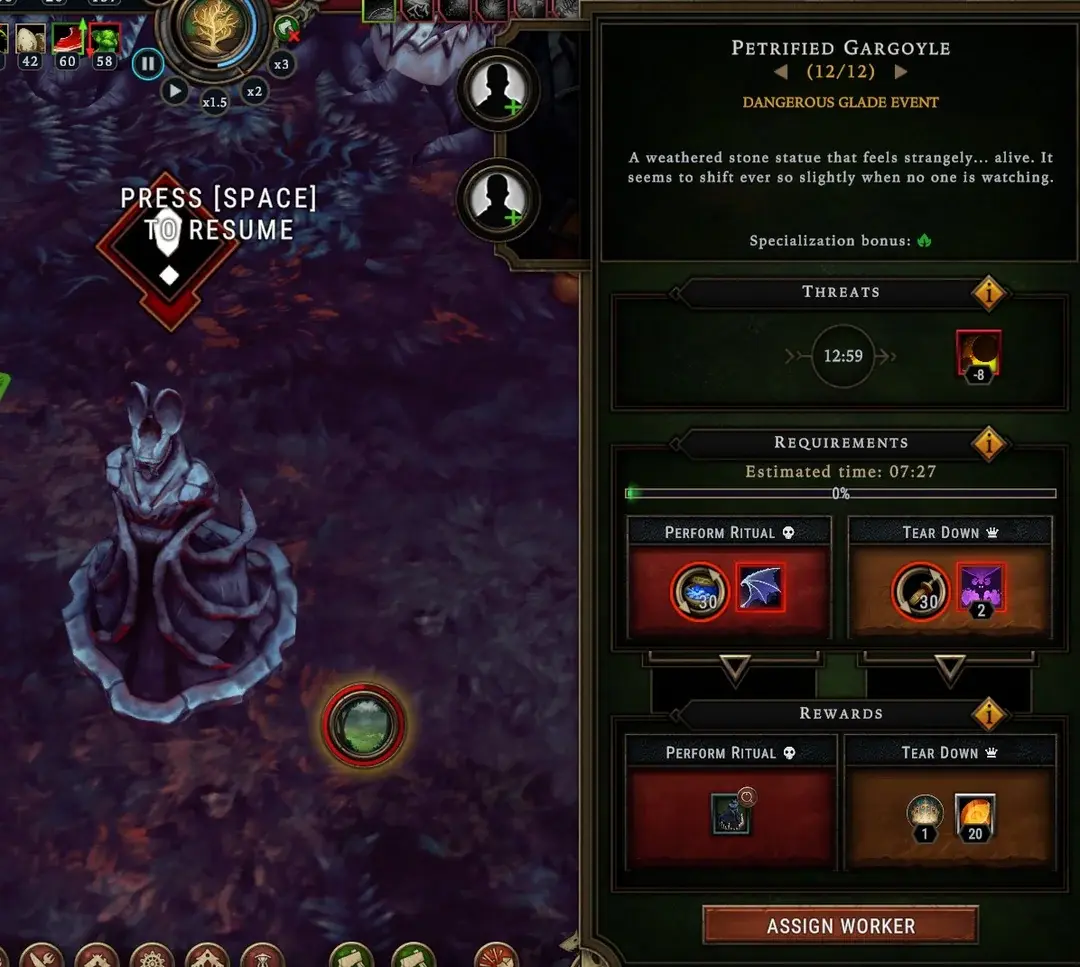
Glades are where Against the Storm becomes interesting. Small Glades can give resources, but Dangerous Glades are usually where the real run-shaping rewards and problems appear — events, caches, ruins, resources, or new opportunities. They can also create penalties if you are not ready.
The key beginner rule: open glades on purpose, not by accident.
Do not let woodcutters randomly chew through the forest until they crack open something you were not ready for. Use tree marking carefully and stop camps before they accidentally open a glade at the worst possible time.
For your first Dangerous Glade, make sure you have:
- enough workers free
- some basic goods stored
- fuel under control
- food not collapsing
- a warehouse close enough if the event is far away
- enough time before the next Storm, if possible
When the glade opens, hit the spacebar and actually read the event — what it needs, what the penalty is, how long it takes, what the reward gives. Many beginner losses happen because players open a Dangerous Glade, ignore the event, and then wonder why the settlement is cursed.
Against the Storm is not asking you to avoid risk. It is asking you to take risk when you can handle it.
The second big mistake: opening too many glades
Opening glades feels exciting — new resources, new events, new rewards, new space. But every opened glade adds pressure, and every extra problem makes the settlement harder to control.
Beginners often open too many glades searching for the "right" resource, then end up with more Hostility, more events, more distance, and more problems than their workers can handle.
A better early habit: open one meaningful glade, solve what is inside, use the reward, stabilize, then open the next one. One solved Dangerous Glade is progress. Three ignored glades are a crisis.
Settlement 4: stop treating Resolve like decoration
Resolve is not just happiness — it is one of your win conditions. If a species has high enough Resolve, it can start generating Reputation over time, meaning happy villagers can help you finish the settlement, especially near the end when Orders alone aren't enough.
Beginners often ignore Resolve until it turns red during the Storm. Don't — instead, know what each species actually wants:
- Humans are the versatile, safe pick for most runs. They're happiest with cooked food like Pie or Porridge and access to a Temple.
- Beavers are strong producers who care about Biscuits and engineering services — keep them busy in Workshops and Lumber Mills and they'll reward you.
- Lizards are the low-maintenance species: they favor Skewers and warmth from the Hearth, and tolerate hunger far longer than the others, which makes them forgiving while you're still learning food logistics.
- Harpies are pickier — they want Crystallized Dew and open, uncrowded surroundings — but they're valuable scouts once their needs are met.
You do not need to satisfy every need. You only need to find realistic wins. If you can make one complex food that helps two species, that's strong. If you can build species housing for the group most likely to generate Reputation, that can be worth it. If a service chain is impossible this run, don't waste the whole settlement chasing it.
Resolve isn't about making everyone perfectly happy all game — it's about knowing when happiness can become Reputation. That's why the late game often shifts: early on, Orders carry you; later, Resolve can finish the job.
Settlement 5: learn to pick blueprints by problem
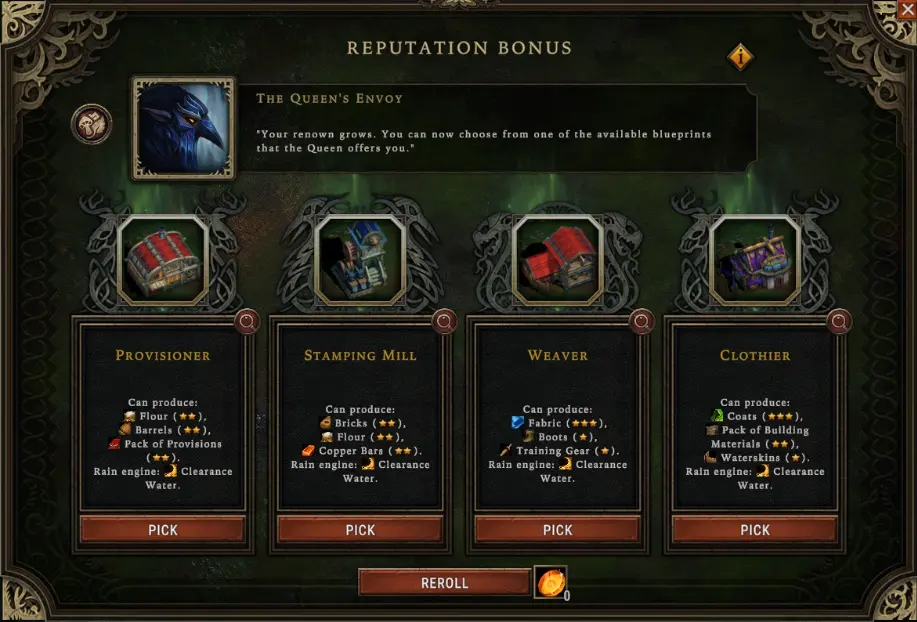
Blueprints are exciting, but they are also a trap. A new player sees a building and thinks, "That sounds useful." But useful in general is not the same as useful right now.
When choosing a blueprint, ask:
- Does this solve food?
- Does this solve building materials?
- Does this help with a species need I can actually satisfy?
- Does this use resources I already have?
- Does this help complete an Order?
- Does this create a production chain I cannot support?
A building that uses resources you don't have isn't a solution — it's future homework. You rarely get a perfect set of buildings in this game; you're supposed to improvise. Pick the building that solves the bottleneck in front of you, not the dream building you'd want in a perfect run.
The same logic applies to Cornerstones, the yearly passive bonus you pick during Drizzle. Don't chase the flashiest option — pick the one that fixes whatever your settlement is actually struggling with right now.
What to build first in most settlements
There's no single perfect build order, since every map changes, but this is a safe beginner flow:
- Hearth and Warehouse area — your production heart. Keep early buildings close so workers waste less time walking.
- Shelters — homelessness is an easy problem to fix early; don't let it become free Resolve damage.
- Woodcutters' Camps — you need wood, but control where they cut. Mark trees toward the glade you actually want to open.
- Food gathering — match camps to nearby resource nodes. Stability beats fancy production early on.
- Basic materials — start producing Planks, Fabric, and Bricks as needed, just enough to keep building.
- Order-specific buildings — once you pick Orders, build toward them.
- Glade support — before opening a Dangerous Glade, make sure you have workers, storage, and some goods ready to respond.
Trade is not optional forever
A lot of beginners ignore trade because they want to make everything themselves. That's a mistake.
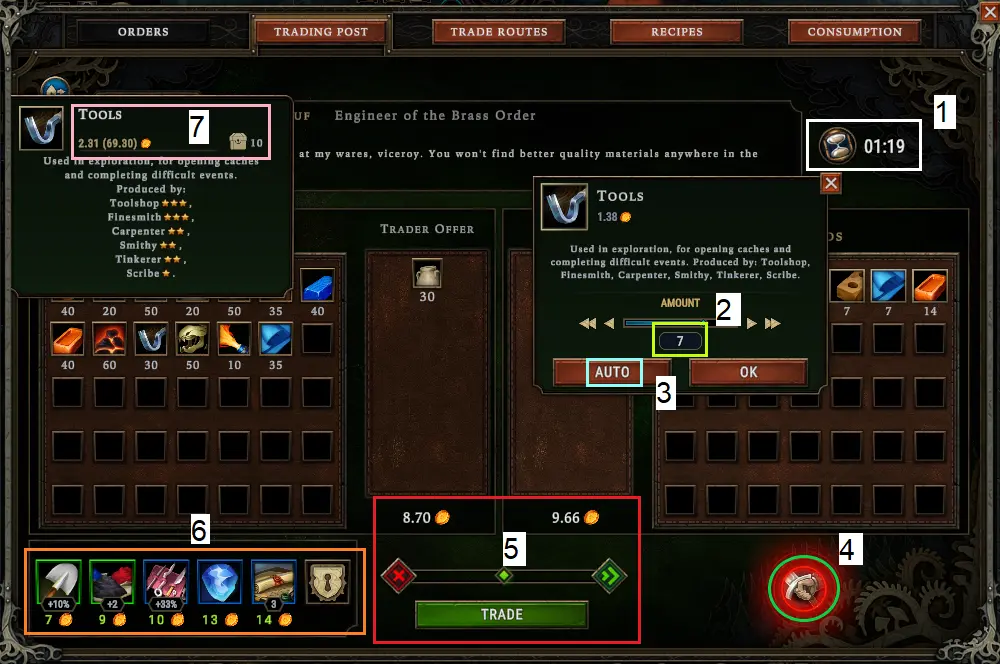
You do not need to produce every item. Sometimes the cleanest answer is to buy what you're missing. Traders can help you complete Orders, solve Glade Events, patch food problems, or get key goods your settlement can't make yet.
This matters because Against the Storm isn't a normal city builder where every production chain is guaranteed. You may not get the building you wanted, or the resource, or the time to build a perfect chain. Trade lets you cheat around missing pieces — in the intended way. If you're stuck because you need one specific material or service good, check trade before rebuilding half your town.
Common beginner mistakes
- Playing like the settlement is permanent. It's not — win and move on.
- Opening glades by accident. Your woodcutters should cut toward a plan.
- Ignoring the Storm until it starts. Check Hostility and Resolve before it hits, not after villagers are already leaving.
- Keeping all woodcutters active during every Storm. Learn to pull them when Hostility is too high.
- Picking blueprints with no resource support. A building is only useful if you can feed it.
- Trying to satisfy every species need. You usually can't do everything — pick the needs you can realistically support.
- Waiting too long to earn Reputation. If years pass and the blue bar barely moves, you're drifting.
- Hoarding goods forever. Resources are tools — use them to complete Orders, solve events, trade, and win.
- Forgetting warehouses. Walking time matters; a small Warehouse near a distant glade or farm can make a big difference.
- Restarting because the settlement is ugly. Ugly is fine. Unstable is the problem.
When your settlement is good enough
A beginner settlement is good enough when:
- nobody is starving
- the Hearth has fuel
- basic materials are available
- Hostility is manageable during Storm
- Orders are getting completed
- Dangerous Glades are being solved, not ignored
- Reputation is moving
- you have a plan for the final push
It doesn't need to be pretty, and it doesn't need every building or a perfectly happy population. If the settlement is moving toward victory, it's working.
The final Reputation push
Many beginner games stall near the end. You complete a few Orders, survive a few Storms, and then the settlement just sits there — Impatience keeps creeping up, Hostility gets worse, and the town starts to feel heavier every year.
That usually means you need a final push. Look for ways to close the game:
- complete remaining Orders
- solve a Dangerous Glade event
- open or send caches if useful
- boost Resolve for one species
- buy missing goods from a trader
- turn stored resources into Reputation
- stop overbuilding and focus only on winning
The end of a settlement isn't the time to start five new production chains. It's the time to ask: what gets me the last few Reputation points? Sometimes the answer isn't elegant. Against the Storm is full of ugly wins.
First-5-settlements cheat sheet
| Settlement | Main focus | You'll know it worked when... |
|---|---|---|
| 1 | Learn the core loop on easy difficulty | You win without worrying about efficiency |
| 2 | Manage Hostility before every Storm | Storms stop feeling random |
| 3 | Open a Dangerous Glade on purpose | You solve the event instead of ignoring it |
| 4 | Use Resolve, not just Orders, for Reputation | At least one species is generating Reputation passively |
| 5 | Pick blueprints by problem, not by hype | You're improvising instead of chasing a fixed build order |
One thing you won't need to worry about yet: Blightrot and Rainpunk Engines. That system only becomes relevant on Veteran difficulty and above. On Pioneer or Settler, it's safe to ignore entirely.
A small setup note for long settlement runs
Against the Storm runs can stretch longer than they look on paper. One more Storm cycle, one more Order, one more blueprint choice — and suddenly it is past midnight. A monitor lamp is a practical comfort upgrade for evening sessions because it brightens your desk without adding glare on the screen.

Quntis Computer Monitor Lamp
Reduces glare and eye strain during long sessions—auto-dimming, clip-on design.
Final takeaway
Against the Storm becomes much easier when you stop treating it like a normal city builder. Your goal isn't a perfect permanent town — it's a settlement that survives pressure, solves problems, earns Reputation, and wins before the forest and the Queen overwhelm you.
For your first five settlements, keep it simple. Build shelter. Secure food and fuel. Make basic materials. Pick Orders you can actually complete. Watch Hostility before every Storm. Open Dangerous Glades on purpose. Choose blueprints that solve real problems. Use trade when your production can't cover everything. Then use Resolve, Orders, and events to finish the run.
Your first settlements will be messy. Good enough is enough if it gets you the win.
Further reading
- Beginner's Guide — Official Against the Storm Wiki
- Reputation — Official Against the Storm Wiki
- Hostility — Official Against the Storm Wiki
- Seasons — Official Against the Storm Wiki
- Resolve — Official Against the Storm Wiki
New to the genre? See best city builder games (2026) and when to choose a city builder over a factory game. Want more pressure-driven picks? Browse games like Frostpunk and the City Builders hub.