Best Overlooked Co-Op Factory & Automation Games
Co-op automation games beyond the belt-and-megabase shortlist — factory defense, terraforming, station engineering, shared industry, and city builders where production chains are the co-op job.
If you and a friend have already finished Factorio, Satisfactory, Techtonica, and Foundry, the honest problem is that the strict-definition co-op factory shelf is nearly empty. Most automation games are built for one person, and the handful that aren't get recycled across every list.
So this one widens the frame on purpose. Some of these are overlooked because barely anyone played them. Others — Astroneer especially — are overlooked as automation games, because they get filed under survival or city building and their production systems never come up in the conversation. That's the thread running through all eight: a co-op game where the real job is building a system that runs without you, whether the output is iron plates, breathable atmosphere, or a functioning economy.
I verified every co-op mode below against the developer, store page, or patch notes. Where co-op arrived years after launch, needs a dedicated server, or comes with real caveats, that's stated plainly. For the mainstream picks, start with the best factory games for co-op and come back here when you've worked through it.
Quick take
- The Riftbreaker is the lead pick and the biggest miss on most lists — a factory-and-defense hybrid that quietly became a four-player game in 2025.
- Astroneer is the one most people already own and never think of as an automation game. Auto arms, extractors, sensors, and rail networks are all in there.
- The Planet Crafter is the chill option. Up to ten players, no combat, and a progress bar that only moves when your machines are running.
- Stationeers is the hardcore pick. Real atmospheric simulation and in-game programming, and genuinely hard to run solo.
- Eco is the most unusual: a civilization where the game mechanically stops you from doing every job, so specialisation isn't a suggestion.
- Anno 1800 has the deepest production chains here. Four players share one faction, one treasury, and a logistics network spanning world regions.
- Anno 117: Pax Romana is the fresher version, and the first Anno where the campaign itself is co-op.
- Kingdoms Reborn is the lightest pick — shared-kingdom city building for groups who want production chains without the ceremony.
The picks
The Riftbreaker
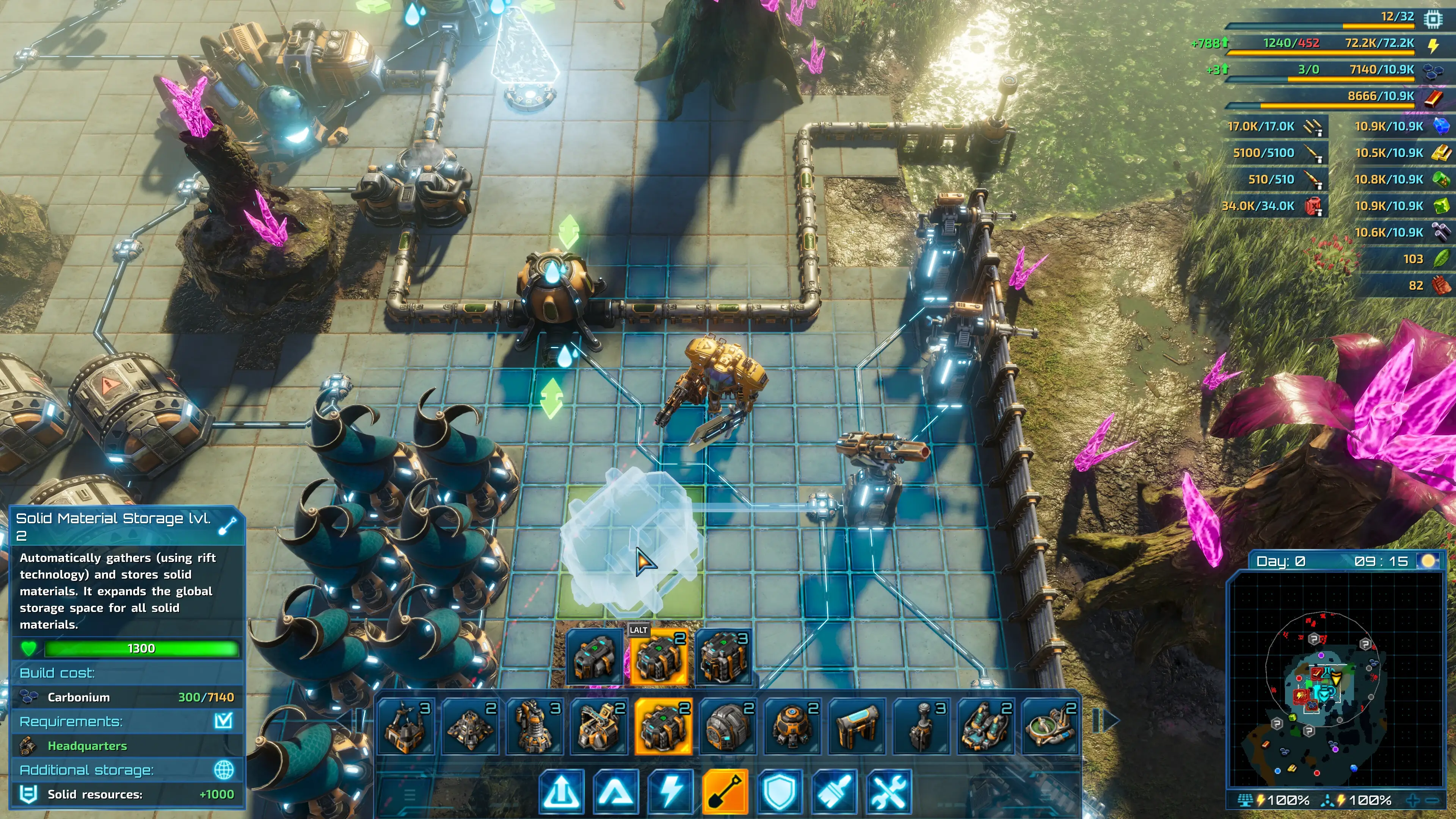
Co-op support: Online or LAN co-op for up to 4 players, covering the full story campaign, survival mode, and the prologue. Co-op shipped with the 2.0 update in August 2025 — it was not in the game at launch, which is exactly why most co-op factory lists still don't include it.
This is the pick most likely to be sitting unplayed in your library. The Riftbreaker launched in 2021 as a single-player game, got reviewed as a single-player game, and then Exor Studios spent years bolting four-player co-op onto it and shipped the whole thing at once.
Mechanically it's a factory game with a survival game's pulse. You're on Galatea 37 in a mech suit called Mr. Riggs, building power grids, resource extraction, and processing chains — and then the local biosphere decides your base is a problem and comes at it in waves. That combination is what makes co-op land. The failure state of the solo game is that one person cannot simultaneously scale production, defend three fronts, and scout for the rare resource that unlocks the next tier. Four players can genuinely split it: one on economy and throughput, one on defensive infrastructure, two pushing outposts. The 2.0 update also added Megastructures — buildings with brutal resource and upkeep demands that function as a shared long-term project. That's an underrated co-op design move. Groups need a goal bigger than "expand," and Megastructures supply one.
It fits players who want their logistics decisions to have consequences beyond throughput numbers. If your group liked Mindustry's pressure but wanted a bigger world underneath it, this is the upgrade.
The tradeoff is genre balance. This is a survival action game with deep automation, not an automation game with light survival, and the ratio won't suit everyone. One buying note: co-op landed on PC storefronts first, with other platforms following later, so confirm your specific version before planning a session.
Astroneer
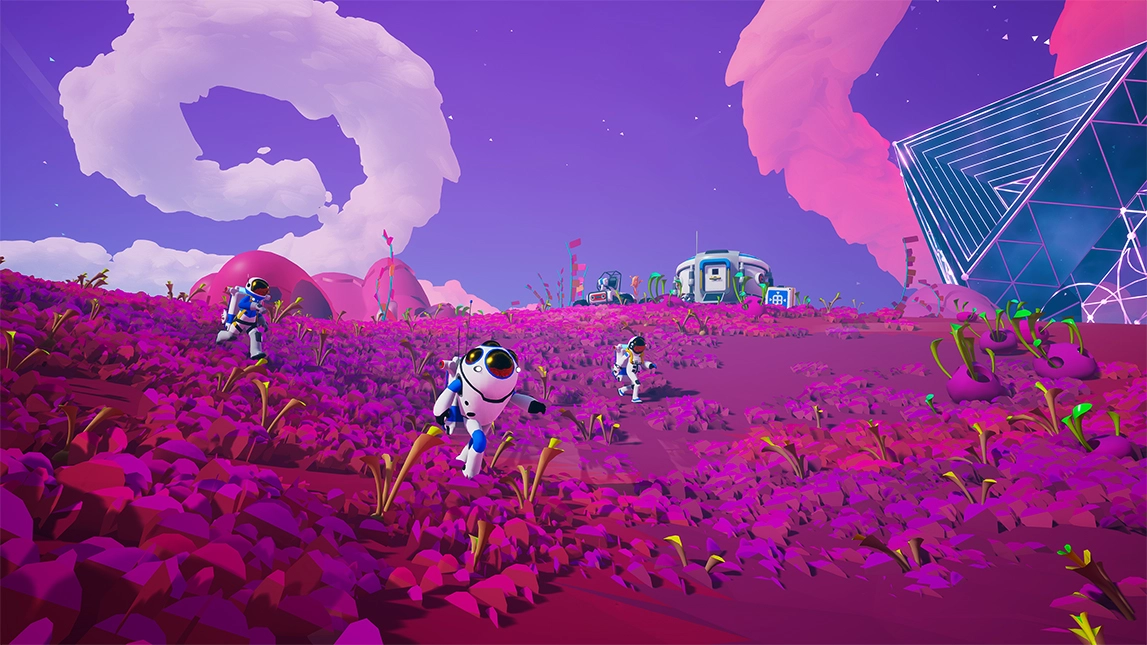
Co-op support: Up to 4 players hosted from one player's machine, joined through your platform friends list. Dedicated servers raise that to 8 and enable cross-play. Everyone must be running the exact same game version, and some DLC saves require all joining players to own the DLC.
Astroneer is not an obscure game — it has sold millions and most people reading this have probably played some of it. What's overlooked is that it has a full automation layer, and almost nobody recommends it in that context.
The 2020 Automation Update added the pieces: Auto Arms that move items between platforms, storage, and vehicles, with resource filters so you can build sorting logic. Auto Extractors that sit on a resource node and pull roughly fifteen times what you'd gather by hand. Sensors that fire on conditions — storage full, storage empty, power dropping — and repeaters to chain them into actual logic. Then rails, with stations that load and unload cars automatically when paired with arms and storage sensors. Put those together and you get remote mining outposts feeding trains that feed a base that processes and stores without anyone standing there. That's a production chain, built in a game most people describe as "the chill space one." In co-op it works well because the jobs are naturally separate: someone terraforms and mines, someone lays rail, someone builds and debugs the automation loop at base.
It fits groups who want Satisfactory's shape with far less friction, and it's the best pick here for a group with mixed patience levels. The art style and low difficulty do a lot of work keeping everyone engaged.
The real criticism, and it's a fair one that's followed the game since 2020: automation unlocks late. The Auto Extractor requires advanced resources, so by the time you can build the interesting systems, you've often finished the content that made you want them. Treat automation as a sandbox reward rather than a progression tool. Also worth knowing before you plan: self-hosted dedicated servers are Windows-only, and Xbox players can't join a non-authenticated home server, so mixed groups usually end up renting.
The Planet Crafter
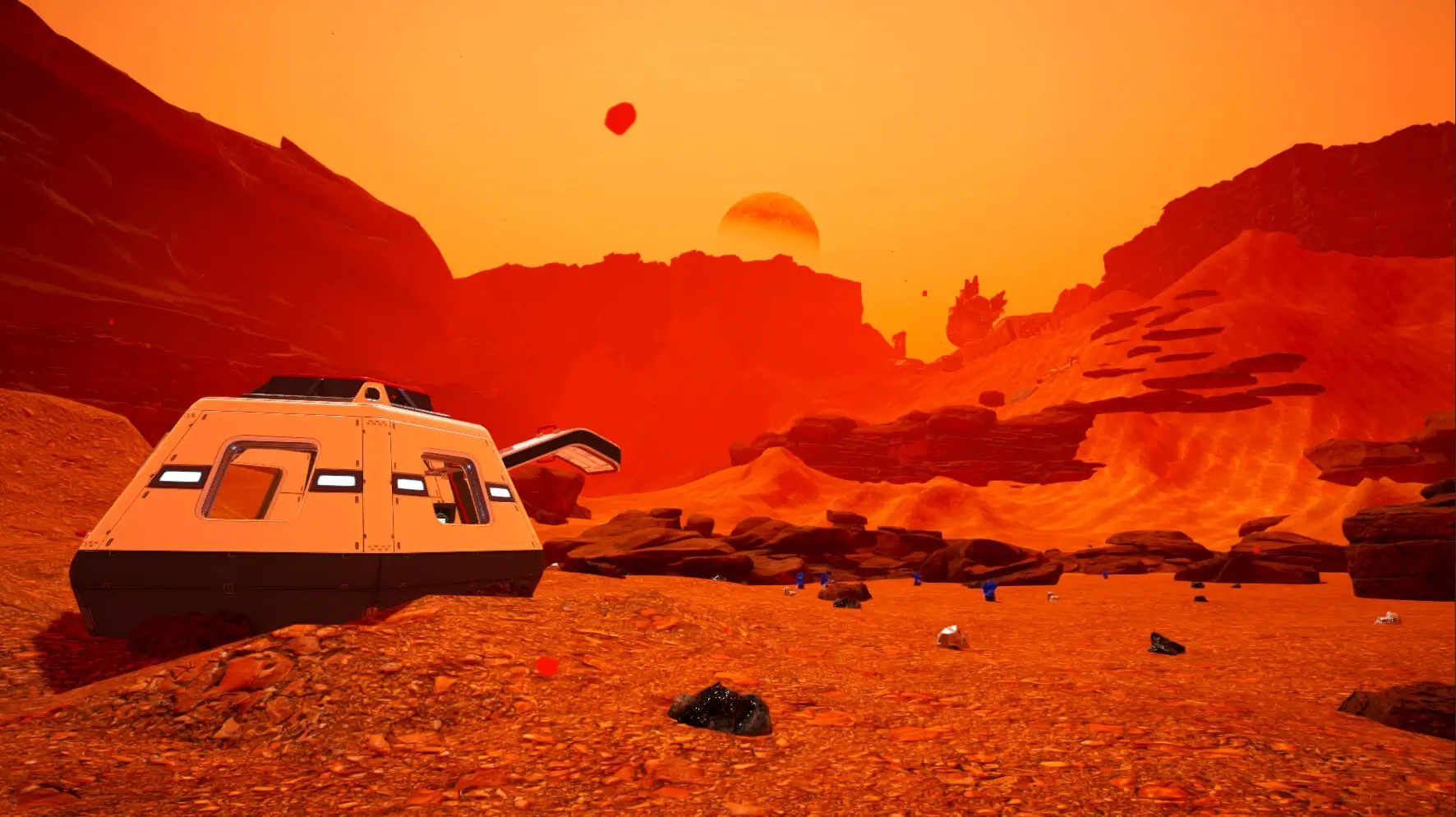
Co-op support: Online co-op for up to 10 players on PC, added in the 1.0 release in April 2024. Joining works through an invitation code rather than a friends list, so cross-storefront groups are fine. It's peer-to-peer, the host's save is the one that persists, and every player needs to own the game.
This is the relaxed entry, and it's a more legitimate automation game than its survival framing suggests.
The whole progression system is a machine output problem. You land on a dead planet and have to raise oxygen, heat, pressure, and eventually biomass to make it habitable, and the only way to move those numbers is to build machines that produce them and keep them supplied. That's a production chain — it just happens to have a terraforming bar instead of a science pack. In co-op the division of labour is unusually clean because the game has genuinely separate jobs: someone explores wrecks and caves for blueprint chips, someone keeps the base powered and expanding, someone hauls and sorts the resources everyone else keeps consuming. Guests can be given the same building rights as the host, so nobody is stuck as a passenger.
It fits mixed-skill groups, couples, and anyone whose co-op partner bounces off Factorio's density. There is no combat at all, which removes the single most common source of co-op friction.
Its limitation is depth ceiling. There are no ratios to optimise, no throughput maths worth doing, and the map is finite — a criticism that follows the game through most of its reviews. Treat it as a satisfying shared project rather than a logistics challenge. It's also peer-to-peer, so players far from the host geographically will feel it.
Stationeers
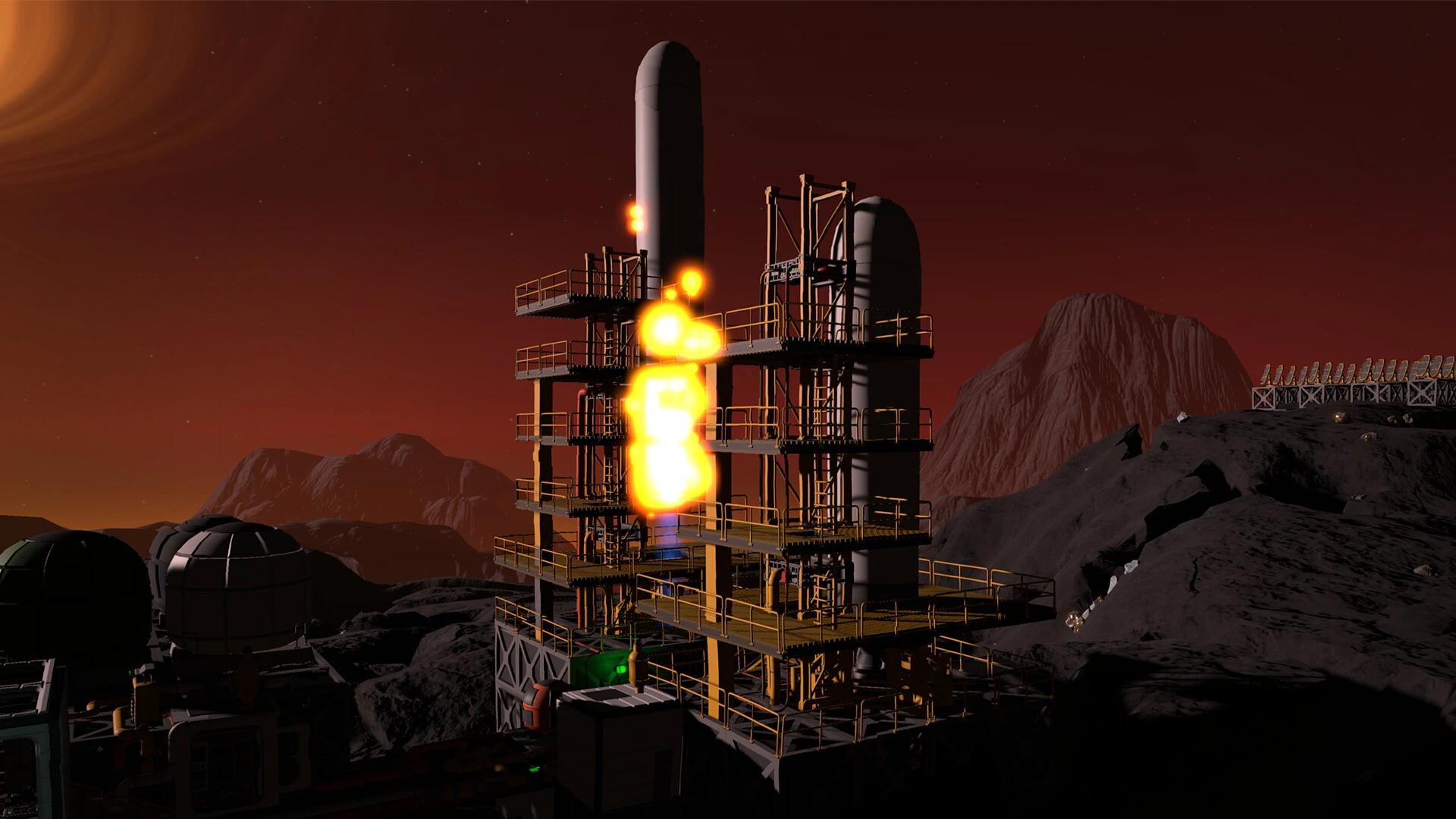
Co-op support: Multiplayer either by hosting from your own session or through a dedicated server, with a default cap around 10 players depending on server settings and hardware. Dedicated is strongly preferred — the simulation is heavy and the host machine carries all of it.
Stationeers is the hardest game on this list by a wide margin, and it's the one where co-op stops being a convenience and starts being close to a requirement.
RocketWerkz built a station sim where the systems are simulated properly rather than abstracted. Atmospherics covers temperature, pressure, combustion, gas mixtures, water, and fire as interacting variables. Electrical grids need transformers, batteries, and load management. Physics includes wall fatigue and explosive decompression, which is exactly as unforgiving as it sounds. And the automation layer is IC10 — an in-game MIPS-like programming language you use to script airlocks, thermostats, solar tracking, and power management. That combination produces the cleanest role division of any game here, because the disciplines are genuinely different skills. One player runs atmospherics, one mines and fabricates, one writes and debugs the IC10 chips keeping everything alive. Nobody is duplicating anyone's work, because nobody else can do that job.
This fits groups with at least one member who reads documentation for fun, and it's the best pick for people whose favourite part of factory games is the moment a system starts running itself.
It is still in Early Access, and the difficulty is not stylised — it's an engineering sim that will kill you over a gas mixture you got wrong. Hosting is fiddly too: the game and query ports both need to be UDP, and getting that wrong is the single most common reason friends can't connect. Budget an evening for setup before you budget one for playing.
Eco

Co-op support: Multiplayer through dedicated servers, with the player cap set by the server. Server-side collaboration settings directly control how much any one player can specialise in.
Eco is the strangest pick here and the most interesting, because it's the only game on the list where co-op is enforced by the rules rather than encouraged by the workload.
You and a group land in a shared world with a meteor arriving in thirty days, and you have to build a civilisation capable of stopping it. The catch is the specialisation system. Skill points accumulate slowly, and the server's collaboration setting determines how many specialties any single player can realistically acquire in the time available. On a high collaboration setting, you simply cannot be the miner and the smith and the farmer and the engineer. Someone else has to be the engineer, and you have to trade with them. That produces a genuine industrial economy: player-run shops, contracts, prices, and a legal system players write themselves to handle pollution and resource depletion, because the ecosystem simulation will punish a group that strip-mines its way to victory. If what you like about factory games is dependency chains, Eco makes the dependencies social.
It fits established groups, communities, and anyone who has ever wanted a game to make trade meaningful instead of a menu.
The caveat is important enough that it should decide your purchase: Eco is balanced around larger servers, not duos. Progression, research pacing, and specialisation lockouts all assume real division of labour across many players, and playing solo or in a group of two or three is a documented grind — small-group scaling is one of the most frequent community requests. If your co-op group is you and one friend, pick something else on this list. If you can fill a server, nothing else here does what it does.
Anno 1800
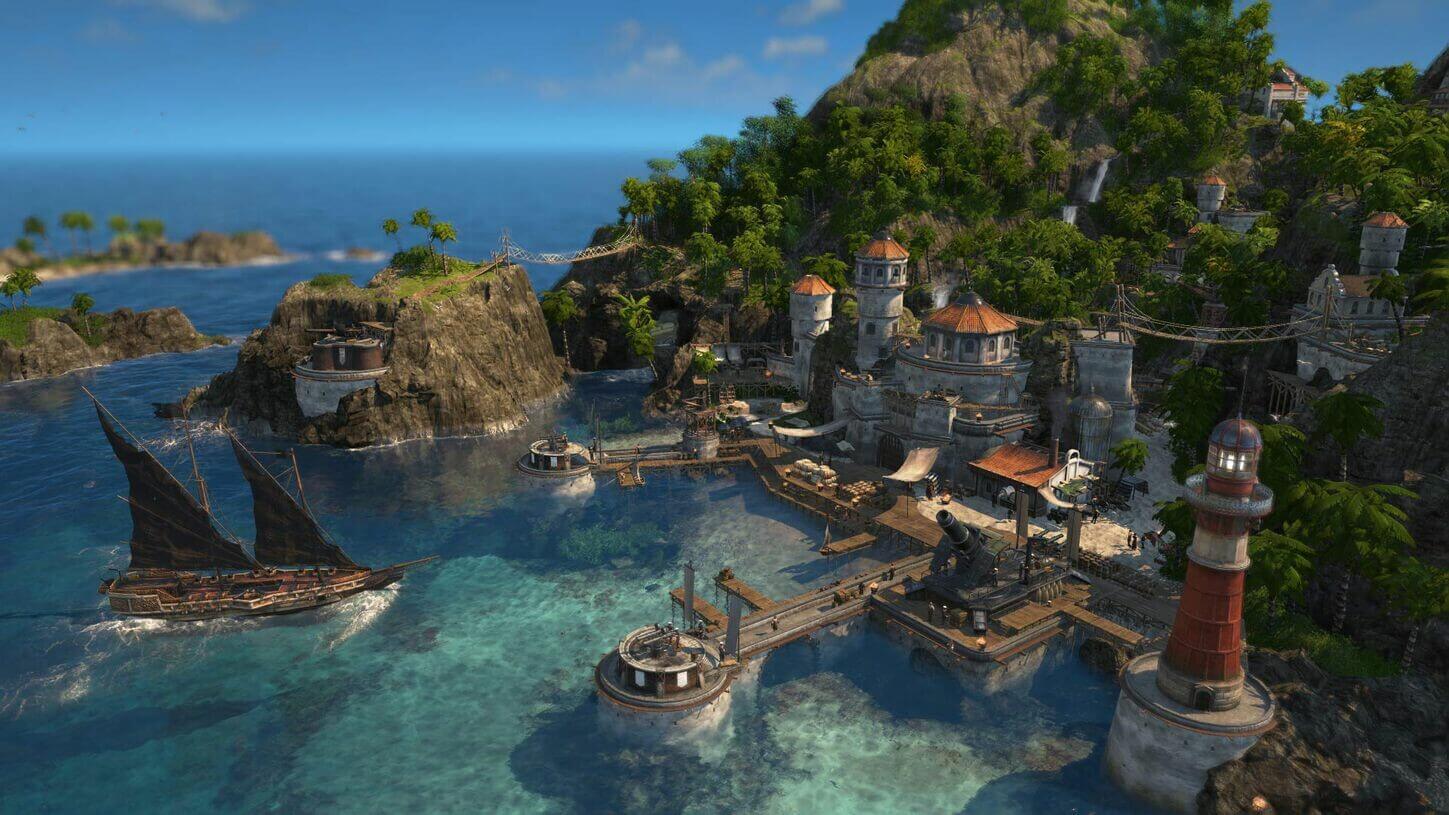
Co-op support: Online co-op for up to 4 players sharing a single faction, added in Game Update 6.0 after launch. Up to four factions per match means a theoretical 16 players on one map.
If you want the deepest production chains on this list, it's this one, and it isn't close.
Anno 1800 is a city builder in presentation and a supply-chain game in practice. Every population tier demands goods requiring multi-step chains, and those chains span separate world regions — you'll be growing and processing in South America to satisfy demand in Europe, which makes shipping routes, warehouse capacity, and trade balance live problems. The co-op implementation is the interesting part: four players don't get four cities, they share one faction. Same treasury, same resources, same islands. That's a more demanding form of co-op than most factory games ask for, because there's no wall between your decisions and your partner's. Reviewers flagged the obvious failure mode immediately — going to buy something and discovering a teammate already spent the money. Handled well, that shared pot is the whole appeal.
This suits groups who like negotiation as much as optimisation, and who want a production game with a real sense of place and period.
The tradeoff is weight. Anno 1800 has accumulated a mountain of DLC, the systems are dense, and onboarding a new player mid-session is rough. It runs in real time with no meaningful pause-and-plan phase in multiplayer, so a deliberating group will feel rushed.
Anno 117: Pax Romana

Co-op support: Online co-op for up to 4 players sharing one governor, with cross-play across platforms. Unlike previous entries, the main campaign is playable in co-op. Cloud "live save games" let any participant continue solo and re-invite the others later. Multiplayer is invite-only.
This is the modernised version of the Anno 1800 pitch, and two of its additions matter more than the setting change.
The first is campaign co-op. Every previous Anno restricted multiplayer to sandbox, which meant co-op groups got the systems but not the structure. Here, up to four players run the entire narrative campaign together as a single governor, sharing resources, money, and territory — the natural split being one player managing Latium while another handles Albion. The second is the live save system, which quietly solves the biggest practical problem in long co-op games: scheduling. Saves live in the cloud, any participant can load and continue alone, and friends rejoin when they're free. If your group has historically abandoned campaigns because you couldn't get four people online on the same evening, that's the feature to notice. Cross-play means mixed PC and console groups work too.
It fits groups who want Anno's production depth with less friction, and it's the better on-ramp of the two Annos for newcomers.
Two honest caveats. It's the newest game here and multiplayer has rough edges: joining a live save already in progress can load a single-player copy instead, and desyncs are reported more often late game — the community workaround is to get everyone into the lobby before loading. There's also no in-game chat, and every player needs matching DLC and mods for a session to work at all.
Kingdoms Reborn
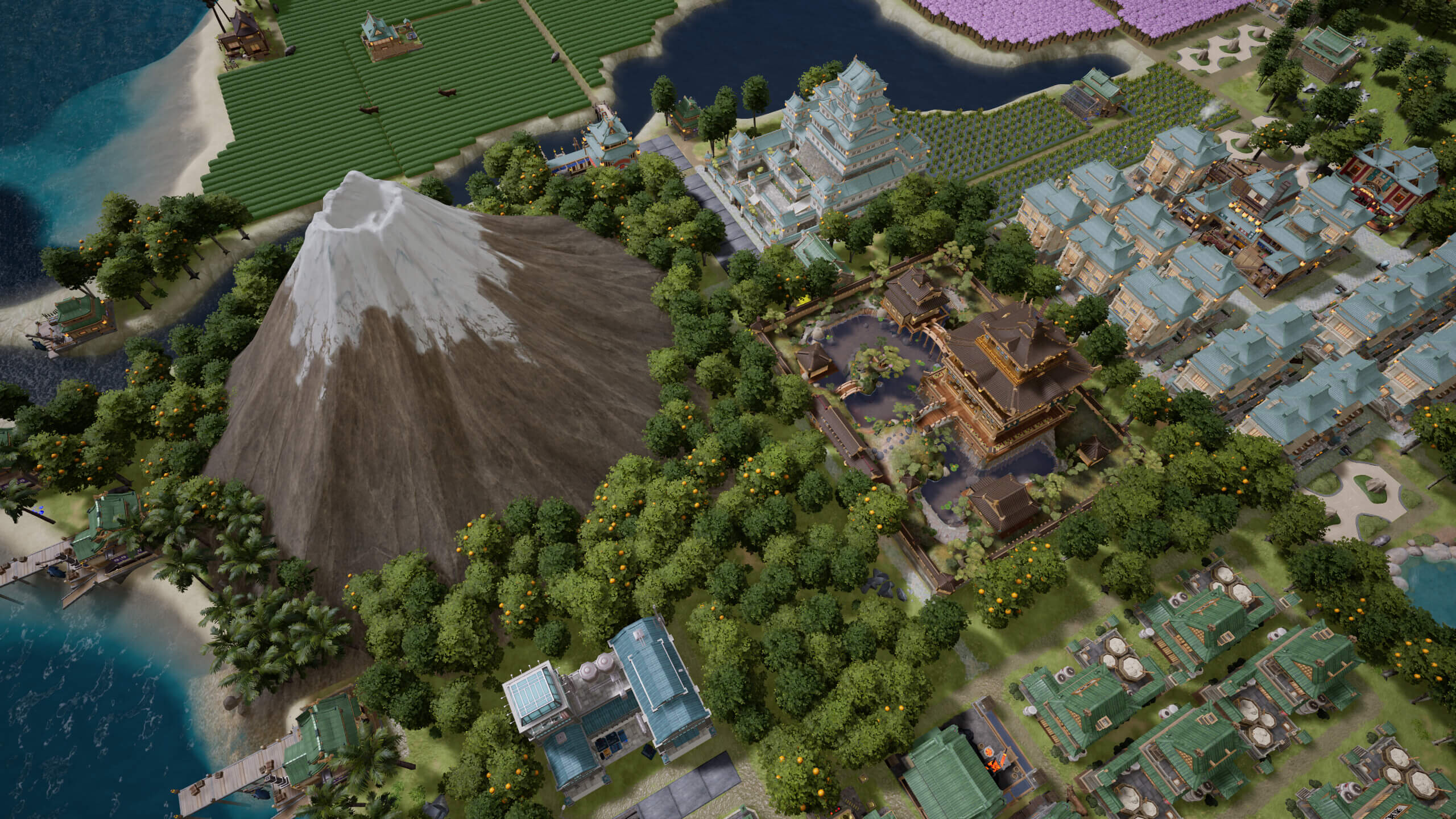
Co-op support: Shared-kingdom co-op added in the July 2023 Co-Op Update, on top of existing competitive multiplayer. The Steam page currently lists collaborative play for up to 18 players; sessions are player-hosted.
Kingdoms Reborn is the lightest pick here, and the right call if the Annos feel like more ceremony than your group wants on a weeknight.
It's a city builder in the Banished lineage — simulated citizens who are born, age, work, and have children — layered with an open procedurally generated world and a card draw system feeding you buildings, policies, and bonuses. In co-op you share a civilisation rather than running neighbouring towns, and the production layer gets interesting once you expand past one settlement: each player takes responsibility for a colony while resources move between them through Intercity Logistics. That's a recognisable factory-game shape in medieval clothes. One person's town produces the input another person's town needs, and somebody has to keep the connection healthy. If the card randomness bothers your group, there's a No Card Draw Mode that removes it — which I'd recommend for co-op specifically, since shared decisions plus random draws is a lot of variance across four people.
This fits groups who want production interdependence with a low barrier to entry, and it's cheap compared to everything else here.
The tradeoff is maturity. It's still in Early Access, past the developer's own target for full release, and multiplayer carries the bugs that implies — save-loading problems and production glitches after updates both show up in community reports.
Which type of player will enjoy these most
These eight split cleanly, because they're far apart in genre:
- Groups who want pressure on their production should start with The Riftbreaker. It's the only pick where something is actively trying to destroy what you built.
- Groups who want the opposite — no combat, no failure states, just machines and progress — want The Planet Crafter.
- Mixed-patience groups where not everyone loves systems should take Astroneer. It's forgiving enough to keep casual players engaged while the automation-minded one builds rail networks.
- Engineering-minded groups who want simulation rather than abstraction belong in Stationeers, provided someone is willing to learn IC10.
- Large groups and communities — six or more — should look at Eco, which is the only game here that gets better as the group grows.
- Supply-chain obsessives who'll happily argue about shipping routes for three hours want Anno 1800.
- Groups with scheduling problems should take Anno 117: Pax Romana for the live save system specifically.
- Budget or mixed-skill groups who want shared production without a learning cliff should try Kingdoms Reborn.
The dividing question is what your group wants to be responsible for. Some of these hand you a shared wallet and make you negotiate. Others hand each player a lane and let them run it. Eco does something rarer — it takes jobs away from you so someone else has to do them.
What matters most when picking your next game
Once you're past the obvious names, "does it have multiplayer" stops being a useful filter. What actually matters:
- Multiplayer is not co-op. Several well-known builders let players share a map while competing. If everyone has their own economy, that's a lobby, not co-op. Both Annos are here because players share one faction — a different thing entirely.
- Check your group size against the design. This matters more than difficulty. Eco is balanced for full servers and punishing for duos. The Riftbreaker and both Annos cap at four and are tuned for it.
- Check when co-op arrived. The Riftbreaker only got it in 2025. Reviews, wikis, and older list articles are simply wrong about it now.
- Find out who's hosting before you buy. Astroneer, Eco, and Stationeers all lean on dedicated servers for their better experience, and that means either renting one or having someone in the group willing to configure ports. Astroneer additionally blocks Xbox players from self-hosted servers.
- Scheduling kills more co-op campaigns than difficulty does. Anything with cloud or persistent saves that survive the host logging off — Anno 117: Pax Romana and any dedicated-server game here — has a far better chance of being finished.
- Early Access means multiplayer bugs. Stationeers and Kingdoms Reborn are the relevant examples. Budget for the session where the save won't load.
A headset pick for long co-op sessions
Shared-treasury and specialisation games live or die on communication, and both Annos ship without in-game chat. A comfortable wireless headset is a practical upgrade if your group runs long planning sessions.

HyperX Cloud III S Wireless
Comfortable wireless headset for long sessions—clear audio, detachable mic.
FAQ
What is the best overlooked co-op factory game?
The Riftbreaker is the strongest pick for most groups. It combines real automation depth with wave defense, supports four players across the full campaign, and it's the game most people don't realise has co-op at all.
Is Astroneer really an automation game?
Yes, though the tools arrive late. The Automation Update added auto arms with filtering, auto extractors, condition sensors, and logic repeaters, and rail stations can load and unload cars automatically. It's a genuine production-chain layer — it just sits behind a lot of progression.
Do any of these have local or split-screen co-op?
Almost none. The one exception is Astroneer on Nintendo Switch, which supports local wireless co-op with other Switch players. Everything else is online, with LAN additionally available in The Riftbreaker.
Which of these works for just two players?
The Riftbreaker, Astroneer, The Planet Crafter, and Kingdoms Reborn all work well as a duo. Both Annos are fine with two but designed for up to four. Eco is the one to avoid — its progression assumes a much larger group.
Do I need a dedicated server?
For Astroneer it raises the cap from four to eight and enables cross-play. For Stationeers it's strongly recommended, since the simulation is heavy and a persistent world means your automation keeps running between sessions. For Eco it's the standard way to play. The rest don't need one.
Are Anno 1800 and Anno 117 actually factory games?
Not strictly — they're city builders. But the core loop is multi-step production chains feeding population demands across regions, which is the same problem factory games ask you to solve. If you enjoy dependency resolution more than belt geometry, both will land.
Which is easiest to start with?
The Planet Crafter or Astroneer. Both have clear goals, no punishing failure states, and progression that tells you plainly whether you're winning. Kingdoms Reborn is next, especially with card draws turned off.
Takeaway
The co-op automation shortlist looks short because most factory games are built for one person. Widening the definition — into defense hybrids, terraforming, station engineering, shared economies, and production-chain city builders — is where the remaining good options actually live.
The Riftbreaker is the pick most people are sleeping on, Astroneer is the automation game hiding inside a game you probably already own, and Eco is the only one here that turns your production chain into a conversation with other people.